He doesn’t pummel the beat, the way so many drummers do.
He pulls it out of the air.
Jo Jones (“Papa Jo” [as distinguished from “Philly Joe“]), October 7, 1911-September 3, 1985
**********
lagniappe
[W]hat really distinguished the great drummers I heard growing up, what really attracted me to men such as Sonny Greer, Chick Webb, Sid Catlett, Jo Jones and Kenny Clarke was that they all thought like composers, they all had their own way of hearing a band. They were all original thinkers who identified themselves when they played. And they stood out. They played like leaders.
Great drummers are like great basketball players—they lift everybody’s game.
Trixie Whitley with Brian Blade (drums) and Daniel Lanois, “I’d Rather Go Blind,” recording session, 2008
lagniappe
Johnny [Vidacovich, featured on 9/30/09], man . . . what an inspiration. His playing is so liquid but at the same time just the street of it is so intoxicating. Studying with him, the drumming aspect was never about fundamental things. It was never about the drums as much as it was about the music and playing with this melodic sensibility. That sticks with me even more than the thickness or the groove, which he never spoke about, really. That was like a given. If you have it inside of you, that groove, you need to lay it down. But also need to be able to sing through the drums.—Brian Blade
World Saxophone Quartet (Julius Hemphill, alto saxophone; Oliver Lake, soprano and alto saxophones; David Murray, tenor saxophone; Hamiet Bluiett, baritone saxophone)
Listening to Julius Hemphill (far left), a phrase from Martin Luther King, Jr.’s “I Have a Dream” speech comes to mind: “the fierce urgency of now.” Hemphill has, it seems, so much to say—right now. Listen, for instance, to 4:30-6:35.
*****
Live, with M’Boom (Max Roach’s 9-piece percussion ensemble), New York (The Cathedral Church of St. John the Divine), 1981 (music starts at 1:55)
Professor Longhair (AKA Henry Roeland [“Roy”] Byrd), December 19, 1918-January 30, 1980
“Tipitina,” live
*****
“Hey Little Girl,” live
**********
lagniappe
mail
Mike Kinnamon, Bonnie Bramlett’s Nashville-based manager, in response to an email letting him (and Bonnie) know that her music was featured here (Delaney, alas, is no longer alive), left a voice-mail message yesterday:
. . . I just love it when somebody like you cares enough to send stuff like that around. It’s really cool, and it lifts her [Bonnie] up, too. Thank you so much, buddy . . .
They weren’t glamorous. And they couldn’t have been paying a whole lot. But everybody, it seemed, wanted to play with them.
Delaney & Bonnie
With Eric Clapton (guitar), Dave Mason (guitar), Bobby Whitlock (vocal); “Poor Elijah-Tribute to Robert Johnson”; live (TV broadcast), England, 1969
•••••
With Eric Clapton (guitar), George Harrison (guitar), Bobby Whitlock (keyboards), Carl Radle (bass), Jim Gordon (drums); “Comin’ Home”; live, England, 1969
*****
With Duane Allman (guitar), Gregg Allman (organ), King Curtis (tenor saxophone); “Only You Know And I Know”; live, 1971
(The bass player, whoever he is, is the MVP here—he lights up everything [check out, for instance, 1:06-1:56].)
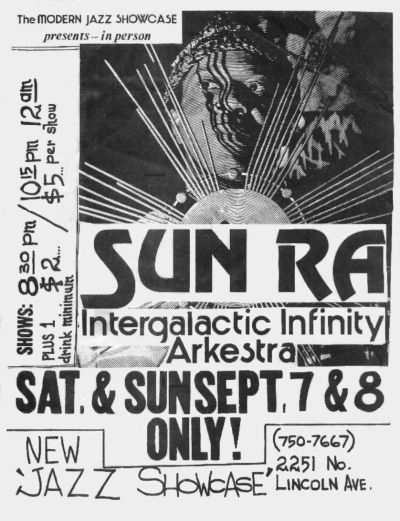
Here’s a big birthday shout-out to my wife Suzanne, who’s not nearly as crazy as I am about music—not nearly as crazy, period—but is crazy enough that she kept going out with me after I took her on our first date, in the summer of 1974, to Chicago’s Jazz Showcase (then on Lincoln Avenue) to see this guy, whose multimedia performance that night featured some of this footage—the stuff with the pyramids.
Sun Ra & His Arkestra in Egypt and Italy, 1971
**********
lagniappe
Even in the excesses of this era there were few audiences prepared for an ominous, ragtag group of musicians in Egyptian robes, Mongolian caps (Mongolian, as from the planet Mongo of Flash Gordon), and B-movie spacesuits who played on a variety of newly invented or strangely modified electronic instruments (the sun harp, the space organ, the cosmic side drum) and proclaimed the greatness of the most ancient of races (this, the Sun Ra of the Solar-Myth Arkestra); or, on yet another night, a merry band in jester’s motley, jerkins, and pointed caps (a la Robin Hood or perhaps the Archers of Arboria) who marched or crawled through the audience, chanting cheerful songs about travel to Venus. It was intensely dramatic music, moving from stasis to chaos and back, horn players leaping about, or rolling on the bandstand, sometimes with fire eaters, gilded muscle men, and midgets, an all-out assault on the senses. At the end of the evening the musicians and dancers moved among the audience, touching them, surrounding them, inviting them to join the Arkestra in marching off to Jupiter.
—John F. Szwed, Space Is The Place: The Lives And Times Of Sun Ra (1997)
*****
Sun Ra’s consistent statement, musically and spoken, is that this is a primitive world. Its practices, beliefs, religions, are uneducated, unenlightened, savage, destructive, already in the past. . . . That’s why Sun Ra returned only to say he left. Into the future. Into Space.
—Amiri Baraka (formerly known as LeRoi Jones)
*****
Silence is music. There are different kinds of silence, each silence is a world all of its own . . . silence is an integral part of all music . . .
***
When you meet a man
You meet a scheme of words
Patterns of concept
A concepted being
Whose very birth conception is called.
***
The earth cannot move without music. The earth moves in a certain rhythm, a certain sound, a certain note. When the music stops the earth will stop and everything upon it will die.
. . . I received five hundred thousand discrete bits of information today, of which maybe twenty-five are important. And how am I going to sort that out, you know?
—David Foster Wallace (in David Lipsky, Although of Course You End Up Becoming Yourself: A Road Trip with David Foster Wallace [2010])
*****
great minds at work
When you see your starting pitcher win a game, that means you’ve played a good baseball game.
—Lou Piniella, talking with Ron Santo on WGN Radio before last night’s Cubs game