music clip of the day

jazz/blues/rock/classical/gospel/more

Category: drums

Sunday, 3/27/11

For some folks singing is as vital as breathing.

Five Star Jubilee Singers, Harriman Junction, Tennessee
Live, “I’ve Been Changed,” “Go Down Moses,” “I’m Just Keeping It Real,” “Open the Floodgates to Heaven,” 2008

Vodpod videos no longer available.

**********

lagniappe

It’s a Friday night in downtown Harriman, and inside the Anointed Praise and Worship Church, the Five Star Jubilee Singers are playing like it’s already Sunday morning.

On drums is Anterrio Ray, 33, an ex-Golden Gloves boxer whose first drum set was a five-gallon bucket and a set of hubcaps. Playing electric bass is Antonio Myers, and that’s his father, Gary Myers, singing four-part harmony with the rest of the band.

They’re an extended family, this nine-member gospel group. When lead vocalist, David Bertram, 60, grabs the microphone, the music kicks in to overdrive. It’s only a rehearsal, but by the third song, Bertram is wiping his brow with a handkerchief.

“With traditional gospel music, you either get saved, or you head for the door,” says vocalist Melinda Bertram, David’s wife. “The Lord is not going to let you just sit there.”

The Five Star Jubilee Singers perform quartet-style harmonies, with electric guitars and drums thrown into the mix. Their style and repertory recall such great black gospel groups as the Swan Silvertones, the Soul Stirrers and the Five Blind Boys of Mississippi. They’ve been playing in and around Harriman for more than 50 years, making them one of the longest-running gospel acts in the region.

During the 1950s, the original Five Star Jubilee Singers won national singing conventions and toured extensively throughout the Southeast.

Today, the group sings at churches and revivals across East Tennessee, for congregations both black and white.

Bertram started singing with the Five Star Jubilee Singers when he was 12 years old. At 18 he moved up North and spent the next 30 years singing professionally with several gospel groups. In 1970, after moving back to Harriman, he convinced the Five Star Jubilee Singers to reunite.

Almost every member of the Five Star Jubilee Singers is related to someone from the original band. Bertram’s older brother, Thurman, was a founding member of the group, as was David Goins. Both these band members are now dead, as is Freeman Goins, David Goins’ younger brother, who died of a heart attack on June 27, 2007, while returning home from a rehearsal.

Every Friday night the band rehearses at the Anointed Praise and Worship Church in Harriman. Arlene Goins, 68, plays electric guitar, and so does her son, William Wright, 42. Including the bass, the Five Star Jubilee Singers have four electric guitars, the newest player being John Dye, of Clinton, Tenn., who joined the group as a rock guitarist.

***

“Our main thing is to get people to come to Jesus,” added David. “I’m going to do this till I lay down. I’m going to sing till He calls me.”

Morgan Simmons, Knoxville News Sentinel, 3/26/08

Saturday, 3/26/11

The notes are easy enough to replicate—the touch impossible.

Pinetop Perkins (piano, vocals), July 7, 1913-March 21, 2011

“Grindin’ Man” (with Willie “Big Eyes” Smith, harmonica), live, New Jersey (New Brunswick), 2008

Vodpod videos no longer available.

*****

“How Long Blues,” live

Vodpod videos no longer available.

**********

lagniappe

He was one of the last great Mississippi Bluesmen. He had such a distinctive voice, and he sure could play the piano. He will be missed not only by me, but by lovers of music all over the world.

B.B. King

*****

If you don’t want to die, don’t be born.

Red Paden, owner of Red’s Blues Club, Clarksdale, Mississippi

*****

my back pages

Many years ago I had the pleasure of working with him, co-producing his tracks on Living Chicago Blues, Vol. 2 (Alligator 1978). Warm, amiable, unassuming—he was easy to like.

*****

listening room: what’s playing

• Ornette Coleman, Town Hall 1962

• Mos Def, The Ecstatic

Lupe Fiasco, Lasers

Steve Reich, Double Sextet, 2×5

Rudresh Mahanthappa & Bunky Green, Apex

Nneka, Concrete Jungle

Theo Parrish, Sound Sculptures, Vol. 1

Powerhouse Gospel On Independent Labels, 1946-1959

WFMU-FM: Sinner’s Crossroads (Kevin Nutt), Mudd Up! (DJ/rupture)

WKCR-FM: Bird Flight (Phil Schapp), Jazz Alternatives (various), Out To Lunch (various), Western Swing Festival (various)

Friday, 3/25/11

Western Swing Festival

Beginning on Friday, March 25th at 8:00 a.m. . . . [we] will honor the legacy of Western Swing with 64 hours of continuous programming, running until midnight on Sunday, March 27th (this will preempt all regularly scheduled programming). We will explore the genre’s entire history, from its roots in the 1920s and 1930s to bands still performing today. The festival will also include live performances and interviews with several Western Swing experts. Grab your ten-gallon hat, lace up those dancin’ boots, and come swing with us!

WKCR-FM (broadcasting from Columbia University)

Bob Wills and His Texas Playboys

“I Hear Ya Talkin'”

Vodpod videos no longer available.

***

“San Antonio Rose”

Vodpod videos no longer available.

***

“Take Me Back To Tulsa”

Vodpod videos no longer available.

Sunday, 3/20/11

Sherman Washington Jr. (Zion Harmonizers)
December 13, 1925-March 14, 2011

Zion Harmonizers with Aaron Neville, “Wonderful,” live, New Orleans (Gospel Tent, New Orleans Jazz & Heritage Festival), 1991

Vodpod videos no longer available.

*****

lagniappe

Sherman Washington Jr., the leader of the Zion Harmonizers and the godfather of the New Orleans Jazz and Heritage Festival’s Gospel Tent, died early Monday at his home in Boutte after a long illness. He was 85.

sherman washington 2002 fest.jpg

What Ellis Marsalis is to jazz, Mr. Washington was to gospel. For three decades, he hosted a Sunday morning gospel show on WYLD-AM that served as the gospel community’s town hall. He led the Zion Harmonizers, New Orleans’ longest-running gospel vocal group, since the 1940s. The Harmonizers appeared at the very first Jazz Fest, staged in 1970 in what is now Armstrong Park.

After the festival moved to the Fair Grounds in 1972, he oversaw the growth of the Gospel Tent, building it into a cornerstone of the festival’s roots-music presentation. The tent introduced a music largely unknown outside the African-American churches where it was born to a much broader audience.

Until deteriorating health finally slowed him down in recent years, he administered the Gospel Tent with a steadfast integrity and intimate knowledge of the music, musicians and singers. Given that many acts consist of large choirs, the tent features more performers than any other stage at the festival.

“Gospel, even after jazz and blues came down to the front of the bus, was still in the back of the bus,” said Jazz Fest producer/director Quint Davis. “To a large extent, Sherman’s work through the Gospel Tent has helped bring gospel music to the front of the bus. An enormous debt is owed to him by the festival, and the whole gospel world.”

Davis expects the upcoming Jazz Fest to feature a tribute to Mr. Washington.

“You can talk about soul with either a lower-case ‘s’ or an upper-case ‘S,'” Davis said. “Sherman had soul with a capital S.”

***

In the late 1960s, the Harmonizers roster included a Mississippi-born bass singer named John Hawkins. In early 1970, Hawkins met Quint Davis at Mason’s Hotel on Claiborne Avenue and came back to Mr. Washington with news of this young music fan who was organizing a music and heritage festival.

Mr. Washington went to meet Davis and partner Allison Miner, and the Zion Harmonizers were booked for the first Jazz Fest at Congo Square. The forerunner of today’s Gospel Tent was a 15-by-20-foot open-sided tent with an upright piano and no floor, stage or sound system.

When Jazz Fest moved to the Fair Grounds in 1972, Davis approached Mr. Washington with an idea.

“Quint said, ‘I had a dream,’” Mr. Washington recalled. “And I thought, ‘This isn’t Dr. King, is it?’ He said, ‘I had a dream that I’m going to build a Gospel Tent, and I want you to run it.’ ”

Mr. Washington’s diplomatic skills came in handy. In the early 1970s, gospel choirs rarely performed outside of churches or church functions. They certainly didn’t perform at “hippie” events where beer was served. Pastors resisted the idea of choirs performing at Jazz Fest.

“The preachers were against me,” Mr. Washington said, “because people would drink beer in the Gospel Tent. I would ask the choir’s president or manager, and he’d tell me yeah. Then he’d come back and say, ‘Our pastor doesn’t want us to sing in the Gospel Tent.’ ”

So instead of church choirs, Mr. Washington booked vocal quartets that weren’t affiliated with churches.

“Those are the ones I had to depend on,” he said. “They would tear the place up, pack it out. We didn’t pay those preachers no mind. We kept going.”

Opinions eventually changed and choirs lobbied Mr. Washington to be included. “I think the choir members got on the pastors about it. Because if a person drinks a beer or something, that’s their soul, not yours. If you’re singing, you’re doing what God wants you to do.”

Eventually, a small staff was assigned to assist Mr. Washington, but he still screened most acts in person. He attended rehearsals and private auditions, offering advice along the way.

“He had never been in a role like this,” Davis said. “He was a true man of God who was not in it to advance himself or build an empire. He worked through his community and spiritual connections to put it all together. He knew who was the real deal, who needed to play.”

Mr. Washington insisted on a high level of professionalism and skill, as he knew any group could well be some Jazz Fest’s attendee’s first exposure to gospel. He wanted the music to make a good first impression.

“This Gospel Tent has brought more white people to gospel than anybody had ever seen, ” Mr. Washington said in 2002. “Now, it’s more white people than black people. And they get into it. It brings the white and black together. People get together and stand up, you don’t know who is who.”

—Keith Spera, The Times-Picayune (New Orleans), 3/14/11

On March 14, 2011 at 2:36 AM, the music stopped and his lyrics became a reality.

Obituary (The Times-Picayune)

*****

listening room: what’s playing

• Bach, Cello Suites, Steven Isserlis, Jean-Guihen Queyras

• Von Freeman, Walkin’ Tuff, Vonski Speaks, Young & Foolish

• Milton Babbitt, Piano Works, Robert Taub

• Buddy & Julie Miller, Written in Chalk

Nneka, Concrete Jungle

Jason Moran, Ten

Steve Lehman, Travail, Transformation, and Flow

Friedrich Gulda, Piano Recital 1959 (Bach, Haydn, Beethoven)

• Theo Parrish, First Floor

• Theo Parrish, Sound Sculptures, Vol. 1

• Roger Sessions, Works for Violin, Cello, Piano; Curtis Macomber (violin), Joel Krosnick (cello), Barry David Salwen (piano)

• Roger Sessions, Sonatas Nos. 1 & 3; Ralph Shapey, Mutations and Mutations II, 21 Variations, David Holzman (piano)

• Yascha Heifetz (violin), Chamber Music Collection, Vol. 1 (Mozart, et al.)

• Morton Feldman, For Bunita Marcus, Stephane Ginsburgh (piano)

Sinner’s Crossroads, Kevin Nutt, WFMU-FM (Thursday, 8-9 p.m. [EST])

Gospel Memories, Bob Marovich, WLUW-FM (Saturday 10-11 a.m. [CST])

Give the Drummer Some, Doug Schulkind, WFMU-FM (Friday, 9 a.m.-noon [EST]; web stream only)

Bird Flight, Phil Schaap, WKCR-FM (M-F, 8:20-9:30 a.m. [EST])

• WFMU-FM, Annual Fundraising Marathon

Saturday, 3/19/11

Sometimes, when the world just seems too noisy, too busy, what you need is something that couldn’t be simpler.

Slim Harpo, “Rainin’ In My Heart” (1961)

Vodpod videos no longer available.

Friday, 3/18/11

Original?

Nah.

But, uh, who cares?

The Hives, “Hate To Say I Told You So,” live, France (Belfort), 6/30/07

*****

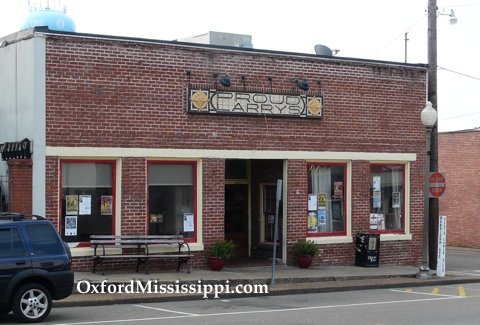
Many of my most vivid musical experiences were the product of serendipity. A few years ago, I spent a long weekend in Oxford, Mississippi, where, as it turned out, these guys had just finished recording an album. Saturday night, as a farewell, they played a little club off the Square. Floor-rumbling, bone-rattling loud they were—and a whole lotta fun.

Proud Larry’s, Oxford, Mississippi

*****

Wednesday, 3/16/11

If I could dance like this, I’d never sit down.

Geri Allen Quartet (GA, piano; Kenny Davis, bass; Kassa Overall, drums; Maurice Chestnut, tap percussionist), “Philly Joe,” live, Detroit, 2009

Vodpod videos no longer available.

More? Here.

Tuesday, 3/15/11

Big Jack Johnson, July 30, 1940-March 14, 2011

Live (Deep Blues, 1992)

“Catfish Blues”

Vodpod videos no longer available.

***

“Daddy, When Is Mama Coming Home”

Vodpod videos no longer available.

**********

lagniappe

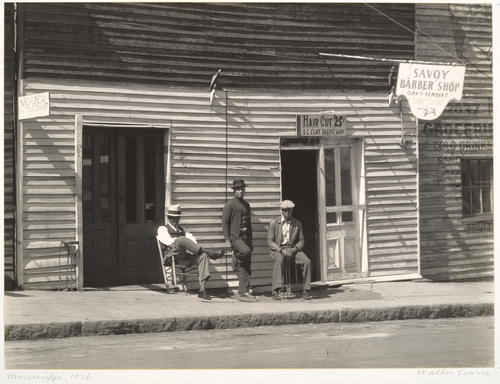
art beat

American Modern: Abbott, Evans, Bourke-White
Art Institute of Chicago (through 5/15/11)

Walker Evans, Barbershops, Vicksburg, Mississippi (1936)

Monday, 3/14/11

Albert King

Fontella Bass

Art Ensemble of Chicago

Fela Anikulapo Kuti

Few musicians travel so widely—or so well.

Lester Bowie, trumpet, October 11, 1941-November 8, 1999

Lester Bowie’s Brass Fantasy (Steve Turre, trombone; Phillip Wilson, drums)
Live, Germany (Berlin), 1986

#1

Vodpod videos no longer available.

***

#2 (Whitney Houston’s “Saving All My Love For You”)

Vodpod videos no longer available.

Lester and drummer Phillip Wilson were kindred spirits. Like Lester, the drummer came out of St. Louis. And like Lester, he roamed freely. Adventurous jazz (Art Ensemble of Chicago), funky soul (Stax Records sessions), hard-rocking blues (Paul Butterfield Blues Band): to each he brought the same hands, the same feet, the same ears.

**********

lagniappe

Bill Cosby on Lester Bowie

Vodpod videos no longer available.

Saturday, 3/12/11

Have you heard of Brandt Brauer Frick?

Rachael Z., the 20-something stylist who cuts my hair

The Brandt Brauer Frick Ensemble, live (rehearsal), Germany (Berlin), 2010

Vodpod videos no longer available.

**********

lagniappe

reading table

Teenager

Me — a teenager?
If she suddenly stood, here, now, before me,
would I need to treat her as near and dear,
although she’s strange to me, and distant?

Shed a tear, kiss her brow
for the simple reason
that we share a birthdate?

So many dissimilarities between us
that only the bones are likely still the same,
the cranial vault, the eye sockets.

Since her eyes seem a little larger,
her eyelashes are longer, she’s taller
and the whole body is closely sheathed
in smooth, unblemished skin.

Relatives and friends still link us, it is true,
but in her world almost all are living,
while in mine almost no one survives
from that shared circle.

We differ so profoundly,
talk and think about completely different things.
She knows next to nothing —
but with a doggedness deserving better causes.
I know much more —
but nothing for sure.

She shows me poems,
written in a clear and careful script
that I haven’t used for years.

I read the poems, read them.
Well, maybe that one
if it were shorter
and fixed in a couple of places.
The rest do not bode well.

The conversation stumbles.
On her pathetic watch
time is still cheap and unsteady.
On mine it’s far more precious and precise.

Nothing in parting, a fixed smile
and no emotion.

Only when she vanishes,
leaving her scarf in her haste.

A scarf of genuine wool,
in colored stripes
crocheted for her
by our mother.

I’ve still got it.

—Wislawa Szymborska (trans. Clare CavanaghStanisław Barańczak; Here [2010])

*****

five desert-island poets

Wislawa Szymborska

William Bronk

John Berryman

Emily Dickinson

Kobayashi Issa