This arrived yesterday, in response to an email letting her know that she was featured here (with Hazel Dickens):
Thanks for letting me know about this. We said goodbye to Hazel yesterday and singing was never more difficult. She was my musical guide and my beloved friend. Smart, funny, complicated, always real. She’ll live in my music, and my life, forever. “Fly away, Little Pretty Bird.”
The desert is where I feel the most comfortable, the most at ease, the most relaxed. It’s also where I’m inspired to create music. To be honest, I don’t like spending too long away from the desert now. Well, that’s to say, I still like touring and travelling and seeing different parts of the globe, but I also like to be at home. And in the desert there are a lot of people who can help us . . . by hiring us a house, by cooking, by playing music with us. We can’t take all those people with us if we go and record in Bamako or Paris.
***
Assouf means nostalgia, homesickness. We’ve all felt it a lot, ever since the time of exile began after the first [Tuareg] rebellion in 1963. It’s the feeling that is most important in our music. But it also means other things. It’s like a pain that you can’t see and can’t touch, a pain that lives in your heart. It means loneliness and separation too. When I was living in Algeria and Libya in the 1980s and 1990s I felt assouf a lot, and that’s when I wrote a lot of the songs I play today.
***
In the desert, everybody is always moving. That’s our culture. It’s very very hard sometimes to get together, or to stay in the same place. We need our freedom. So Tinariwen has survived because really almost every Tamashek musician in the northeast of Mali or the south of Algeria is part of Tinariwen. And if just two of them come together to sing our songs, that’s enough for it to be Tinariwen. In the past, that’s how our concerts happened. Hassan and Abdallah might perform in Bamako or Abidjan while I was hundreds of miles away in Tamanrasset or someplace. So I know that some people have been frustrated for example when I haven’t been present on stage in America. But that’s how Tinariwen has always been, loose and flexible. Otherwise we could never survive.
joy, n. a source of keen pleasure or delight. E.g., the singing of Eddie Jefferson.
Eddie Jefferson, jazz singer, August 3, 1918-May 9, 1979
Live (with Richie Cole, alto saxophone; John Campbell, piano; Kelly Sill, bass; Joel Spencer, drums), Chicago (Jazz Showcase), 5/6/79 (days later, outside a jazz club in Detroit, he was shot to death)
Vodpod videos no longer available.
**********
lagniappe
art beat: yesterday at the Art Institute of Chicago
Mark Rothko, Untitled (Purple, White, and Red), 1953
No painting has held my gaze more often, or meant more to me, than this. It’s different every time I see it.
*****
reading table
ROTHKO: Look at the tension between the blocks of color: the dark and the light, the red and the black and the brown. They exist in a state of flux—of movement. They abut each other on the actual canvas, so too do they abut each other in your eye. They ebb and flow and shift, gently pulsating. The more you look at them the more they move . . . They float in space, they breathe . . . Movement, communication, gesture, flux, interaction; letting them work . . . They’re not dead because they’re not static. They move through space if you let them, this movement takes time, so they’re temporal. They require time.
Steve Reich, Bang on a Can All-Stars (Robert Black, bass; David Cossin, drums; Evan Ziporyn, piano; Bryce Dessner & Derek Johnson, guitars)
Rehearsal, 2×5 (S. Reich), 2009
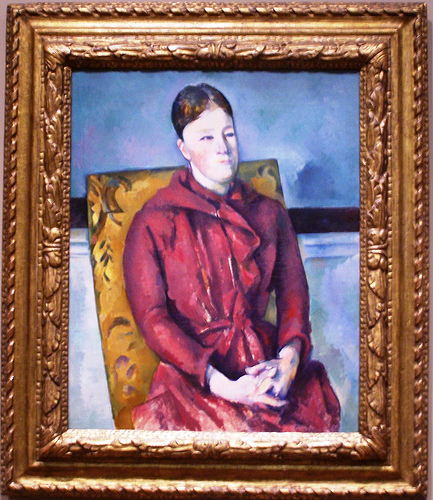
Paul Cezanne, Madame Cezanne in a Yellow Chair, 1888-90
***
Here’s what’s on its right.
Paul Cezanne, The Basket of Apples, c. 1893
***
And here’s what’s on the adjacent wall.
Paul Cezanne, Harlequin, 1888-90
(on loan from the National Gallery of Art, Washington, D.C.)
***
I still work with difficulty, but I seem to get along. That is the important thing to me. Sensations form the foundation of my work, and they are imperishable, I think. Moreover, I am getting rid of that devil who, as you know, used to stand behind me and forced me at will to “imitate”; he’s not even dangerous any more.
—Paul Cezanne (last letter to his son Paul, dated October 15, 1906, a week before his death; quoted in Ambroise Vollard, Cezanne)
*****
Art ______ of Chicago
In the department of duh, after decades of going there and decades of listening to them, I’ve just noticed the verbal similarity between the Art Institute of Chicago and the Art Ensemble of Chicago.
Charles Mingus, bassist, bandleader, composer
April 22, 1922-January 5, 1979
In celebration of Mingus’s birthday, WKCR-FM (broadcasting from Columbia University) is playing his music all day. We’re celebrating by revisiting some favorite clips.
**********
Duke Ellington, Count Basie, Miles Davis: so many of the greatest figures in jazz weren’t just great musicians, or composers, or arrangers. They were great bandleaders. As important to their artistic success as anything else was their ability to find, and showcase, players who could make the music come alive—people like Johnny Hodges and Ben Webster and Jimmy Blanton and Lester Young and Freddie Green and Jo Jones and John Coltrane and Bill Evans and Tony Williams.
That small circle of elite bandleaders includes this man. He hired musicians who played their instruments like no one else (Eric Dolphy, Jaki Byard, et al.). He gave them a musical setting in which structure and freedom were exquisitely balanced. And together they made music that sounds (even on something familiar) like nothing else.
Charles Mingus Sextet (with Johnny Coles, trumpet; Jaki Byard, piano; Eric Dolphy, alto saxophone and bass clarinet; Clifford Jordan, tenor saxophone; Dannie Richmond, drums), “Take the A Train,” live, Norway (Oslo), 1964
**********
lagniappe
I nominate Charles Mingus one of America’s greatest composers—Ran Blake (in the liner notes to his recent album Driftwoods)
(Originally posted 12/1/09.)
**********
No jazz composer since Thelonious Monk has a stronger voice.
Lyrical beauty, inexhaustible drive, deep feeling: what more could you ask for?
Charles Mingus Quintet (CM, bass; Dannie Richmond, drums; Eric Dolphy, alto saxophone, bass clarinet; Clifford Jordan, tenor saxophone; Jaki Byard, piano), live (TV broadcast), Belgium, 1964
“So Long, Eric”
*****
“Peggy’s Blue Skylight”
*****
“Meditations on Integration” (excerpt)
**********
lagniappe
. . . [Mingus’s] music was pledged to the abolition of all distinctions: between the composed and the improvised, the primitive and the sophisticated, the rough and the tender, the belligerent and the lyrical.—Geoff Dyer, But Beautiful: A Book About Jazz (1996)
*****
Making the simple complicated is commonplace; making the complicated simple, awesomely simple, that’s creativity.
***
I, myself, came to enjoy the players who didn’t only just swing but who invented new rhythmic patterns, along with new melodic concepts. And those people are: Art Tatum, Bud Powell, Max Roach, Sonny Rollins, Lester Young, Dizzy Gillespie and Charles Parker, who is the greatest genius of all to me because he changed the whole era around.
***
In my music, I’m trying to play the truth of what I am. The reason it’s difficult is because I’m changing all the time.
I live in Dakhla [in Western Sahara]. There are other groups in the area, but Group Doueh is the main group for this area. We are the most in demand group for weddings and parties.
***
The power of Jimi Hendrix’s guitar is something that is inspirational on so many levels.
***
The main group is myself on guitar and tinidit. My wife Halima and friend Bashiri are the vocalists. My son Jamal is the keyboardist. There are also many percussionists that play with us from time to time. Also other singers will perform with us depending on who is available for certain weddings or parties.
***
For many years, most of our material was recorded on cassette. I have had many cassette recorders, some two-track, four-track and eight-track models. Now I am able to record digitally to a 16-track model. I am always experimenting to get the best situation. We always record at home and we record all of our performances.
***
[T]here really is no [music] industry [in Western Sahara]. I am an industry unto myself. I record music and have two shops that sell music to the community. Most of the recordings are done at home in makeshift studios, and cassettes or CDs are sold throughout the region.
art beat: yesterday at the Art Institute of Chicago
Paul Cezanne, The Bay of Marselleilles, Seen From L’Estaque, c. 1885
The greatest jazz musicians—Miles Davis, Ornette Coleman, Von Freeman, et al.—can be identified by just one note. Cezanne’s that way, too. His blues are all his own.
Billy Bang (AKA William Vincent Walker), violinist, 9/20/47-4/11/11
Billy Bang Quintet (BB, violin; Frank Lowe, tenor saxophone; Ahmed Abdullah, trumpet; William Parker, bass; Abbey Rader, drums), live, New York (Knitting Factory), 10/1/00
Vodpod videos no longer available.
*****
Billy Bang Quartet (BB, violin; Ngo Thanh Nahn, dan tranh; Todd Nicholson, bass; Shoji Hano, drums), live, New York (Vision Festival X), 6/18/05
Vodpod videos no longer available.
**********
lagniappe
As I lived in Harlem in the early Fifties as a kid, I heard music all around me from the jazz clubs and from the candy stores. They had speakers outside the candy stores that they would play music, music like Eddie Harris and once in a while, Brubeck’s “Take Five.” So I started hearing jazz very, very early, and when you lived in Harlem in those days, it was in the blood. It was in the people. It was in the clothing. It was prevalent. As a young man, I bought a pair of bongos and two of my friends and I used to play the bongos on the New York City subway system. We would take turns dancing and playing the bongos and earn some money. That was my professional debut in the music.
***
I bought the Delmark records and heard Leroy Jenkins. Then I started hearing all the Joseph Jarman and Roscoe Mitchell. I loved the AACM. I loved Delmark for putting them out, Muhal Richard Abrams. This music really turned me on. It seemed very political, very conscious for me at the time and also very free, but with structure. So when Leroy Jenkins came to New York, I tracked him down and I did a little study with him for about six months. It was enough to reshape my direction. I already had a direction, but it really straightened it. From that point on, I just kept trying to go for it. Nobody would hire me, but that didn’t stop me. I would hire myself and hire a band and we would play at places like lofts in New York. Eventually, loft jazz became very, very big in New York and that catapulted my name and my career. During that period, I did all sorts of things, sitting in with Sam Rivers at The Five Spot. I sat in with Jackie McLean. I just had to be around the music and the cats that I loved and respected. I was disappointed that John Coltrane passed away because I think I would have followed him day after day after day to try and get in his band.
***
[The loft scene] was a very big thing. I think that catapulted my name internationally along with the David Murrays, the Henry Threadgills, the Frank Lowes, the Lester Bowies, the Joe Bowies. A lot of us wrote our own compositions. We weren’t playing standards. The bebop guys had to play standards to be legitimate. We were able to create our own music, direction, and compositions that also helped to lend a more directional input into the music. The loft jazz’s impact of it came when the Newport Jazz Festival came to New York that year and they didn’t hire any of us, so we had our own loft jazz festival. There were meetings and I remember Archie Shepp was talking and Rashied Ali was talking. I was very, very happy to be in New York at that time and to be around such a powerful movement with powerful names in it, Braxton, a lot of cats, all the cats that I love. We started setting up concerts all over, all the places. Sam Rivers had Rivbea and Rashied Ali had Ali Alley, which is where I played most of the time. When I played there with my Survival group, Werner Uehlinger came from hatHUT and he signed me to do a solo record. We were very adamant and strong about what we were doing. We were committed in belief. The World Saxophone Quartet started. The String Trio of New York started. Air was here. There was a lot of power going on simultaneously. There was a movement going on. We actually saw it in the making. I find it extremely important. The only reason why it does not have as much importance as I see it is because a lot of the writers didn’t pick up on it. Francis Davis from Philadelphia, he did and Stanley Crouch to some degree. There were people that picked up on it, but it wasn’t enough of a movement. The next year, George Wein hired some of the loft guys to play at the jazz festival. I was even offered a gig there with the String Trio. I didn’t make it because I like to hold out. I will be very honest, Fred. After I did my tour in Vietnam, I felt above a lot of the everyday activities in this world. I faced death and I think I had died more than once, so after that, I was sort of an untouchable. Me with my music, I didn’t feel the threatening situation that others felt. I didn’t feel obligated to have to compromise or the necessity to have to kiss anybody’s ass. I was determined to be focused in a Billy Bang direction until today, I am the same way. I think that strength is what kept me going, that commitment of strength, that conviction. They didn’t like the things that I did in the beginning. In fact, I didn’t like a lot of it, but I was committed enough to keep trying and not be shot down by critics, writers, peers, whomever.
***
Cats [today] are trying to be technical. You can exercise all your technical prowess and you sound like what’s been out already. I hear more guys sound like Clifford Brown or Freddie Hubbard then I heard them do. That was not the thing. We were always going for individual voices and individual sound. That is the only thing that almost made me stop. I didn’t sound like anybody. I thought I sounded so horrible that one particular day, I was ready to smash up my violin and I remember James Jackson from the Sun Ra band came in and tried to recruit me and he had a long talk with me. He told me that I had my own sound and that I had a Billy Bang sound. I took that to heart and started working from that perspective and saying that I needed to keep working at it and developing my sound.