This I bumped into yesterday, while taking a break from work (murder case, tax stuff, etc.). I found it enthralling—maybe you will too.
Okkyung Lee (cello), live, Ireland (Cork), 2012
**********
lagniappe
radio
Today, on the heels of yesterday’s celebration of Ornette Coleman, WKCR (Columbia University) is hosting yet another birthday marathon—this one for jazz cornetist Bix Beiderbecke, born on this date in 1903.
Frankie Trumbauer and His Orchestra (with Bix Beiderbecke [1903-1931], cornet), “I’m Coming Virginia” (1927)
Michael Zerang and the Blue Lights (MZ, drums; Mars Williams, alto saxophone; Dave Rempis, baritone saxophone; Josh Berman, cornet; Kent Kessler, bass), live, Chicago (Hideout), 2013
**********
lagniappe
reading table
Now, in general, Stick to the boat, is your true motto in whaling; but cases will sometimes happen when Leap from the boat, is still better.
Bobby Bradford (cornet), Glenn Ferris (trombone), Mark Dresser (bass), “Purge” (G. Ferris), Los Angeles, 2009
A mathematician could, I’m sure, estimate how many different instrumental combinations you could expect to hear in your lifetime. What that number would be I have no idea. What I do know is that this particular combination—cornet, trombone, bass—is one that, in over fifty years of listening, I’ve never heard before.
**********
lagniappe
radio
Today the folks at WKCR-FM (Columbia University) are remembering trumpeter Roy Eldridge, who was born on this date in 1911 and lived until 1987, in the best possible way—they’re playing his music all day.
*****
reading table
[W]hen, in a simple case, one sees the barrister step forward, raise a robed arm and begin declaiming in an ominous voice, nobody dares look at their neighbors. Because to begin with one thinks it is grotesque, but then it seems it might be wonderful, and one waits to make up one’s mind.
—Marcel Proust, Finding Time Again (translated from French by Ian Patterson)
exhilarating, adj. making you feel happy, excited, and full of energy. E.g., the music of Anthony Braxton.
Ken Vandermark, arrangments, bass clarinet; Nick Mazzarella, alto saxophone; Mars Williams, alto saxophone; Dave Rempis, baritone saxophone; Josh Berman, cornet; Jeb Bishop, trombone; Jason Adasiewicz, vibraphone; Nate McBride, bass; Tim Daisy, drums; live, Chicago (Elastic, 2830 N. Milwaukee), 6/21/12
Composition No. 6 C (A. Braxton)
***
Composition No. 69 J (A. Braxton)
**********
lagniappe
Anthony Braxton sat perched on a piano bench one recent afternoon, hands folded in his lap, wearing an intent but unreadable expression. Angled away from the piano in a no-frills rehearsal space in Brooklyn, he faced the dozen or so vocalists that currently make up his Syntactical Ghost Trance Music Choir. The singers, arranged in a semicircle, were tackling Mr. Braxton’s “Composition No. 256,” staring hard at their sheet music while trying to keep track of their conductor. It was starting to seem as if the piece, a slippery, scalar proposition, were getting the best of them.
“O.K.,” said Taylor Ho Bynum, the conductor, waving the singers to a halt. Mr. Bynum, a cornetist, composer, bandleader and former student of Mr. Braxton’s at Wesleyan University, took a moment to describe the cues and signals that would further convolute the interpretation of the piece. “When in doubt, we follow Braxton,” he said.
“Which is to say, you know it’s going to be wrong!” Mr. Braxton fired back, laughing.
Mr. Bynum nodded, deadpan. “We’d follow Braxton off a cliff.”
***
Mr. Braxton, 66, has been a force in the American avant-garde since the 1960s, when he emerged in his native Chicago as a member of the Association for the Advancement of Creative Musicians. Within the first decade of his arrival, he was being toasted in some circles as “the new messiah, the new Charlie Parker-John Coltrane-Ornette Coleman,” as Whitney Balliett put it in The New Yorker.
As a composer, conceptualist and saxophonist, Mr. Braxton exemplified the steep intellectualization of one wing of jazz’s avant-garde; his compositions often included notation in the form of pictographs and algebraic formulas, and he wrote pieces not only for jazz ensembles but also for classical orchestras (in one memorable instance, for four of them at once). One piece from 1971, “Composition 19 (For 100 Tubas),” finally had its premiere five years ago as a rumbling overture to that year’s Bang on a Can Marathon in Lower Manhattan.
“I wanted to have an experience like my role models,” Mr. Braxton said after the rehearsal, at a nearby pub. “Karlheinz Stockhausen, Charlie Mingus, Iannis Xenakis, Sun Ra, Hildegard von Bingen. The people who were thinking large scale and small scale. I might not have been able to get the money to do what I would have liked to do. But you can still compose it and have the hope that maybe in the future it can be realized.”
Mr. Braxton has often suggested that his sprawling output — and the equally irreducible theoretical discourse surrounding it — should be understood as a single body of work. To that end, his music has become a bit more accessible recently, thanks to a spate of archival releases. But that hasn’t made things easier for Mr. Braxton.
“This is a somewhat frustrating time cycle for me, in the sense that I rarely work anymore,” he said. “My work has been marginalized as far as the jazz-business complex is concerned, or the contemporary-music complex.” Were it not for his tenured post at Wesleyan, where he has taught for more than 20 years, “maybe I would be driving a taxicab or something,” he said.
***
“I had never thought that I would be involved in narrative structures,” Mr. Braxton said [of his new opera Trillium J]. “As a young guy, I was more interested in abstract modeling. But as I got older, I began to see that there was no reason to limit myself to any intellectual or conceptual postulate, when in fact I’m a professional student of music.”
Peter Brötzmann Chicago Tentet,* “Aziz” (M. Zerang), recorded live in Chicago (Empty Bottle), 9/17/97 (Okka Disk OD-12022)
**********
lagniappe
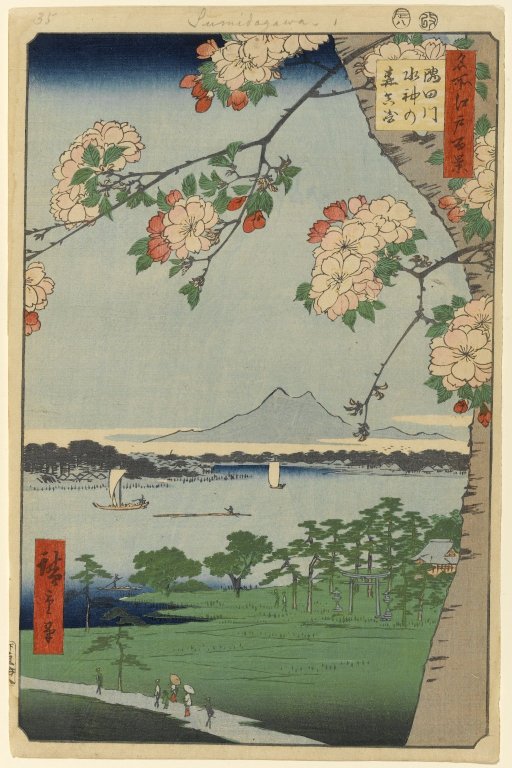
art beat: yesterday at the Art Institute of Chicago (after meeting with a client at the nearby federal jail)
Utagawe Hiroshige, Suijin Shrine and Massaki on the Sumida River (from the series One Hundred Famous Views of Edo), c. 1856
*****
reading table
Were I to choose an auspicious image for the new millennium, I would choose . . . the sudden agile leap of the poet-philosopher who raises himself above the weight of the world, showing that with all his gravity he has the secret of lightness, and that what many consider to be the vitality of the times—noisy, aggressive, revving and roaring—belongs to the realm of death, like a cemetery for rusty old cars.
—Italo Calvino, “Lightness,” in Six Memos for the New Millenium (1988, translated from Italian by Patrick Creagh)
*****
*PB, tenor sax/clarinet/tarogato; Mars Williams, tenor/alto/soprano sax/clarinet; Ken Vandermark, tenor sax/clarinet/bass clarinet; Mats Gustafsson, baritone sax/fluteophone; Joe McPhee, pocket cornet/valve trombone/soprano sax; Jeb Bishop, trombone; Fred Lonberg-Holm, cello; Kent Kessler, bass; Michael Zerang, drums/percussion; Hamid Drake, drums/percussion.
How many sonic experiences are as dizzying as the one offered this time each year by WKCR-FM (Columbia University)? First there’s 24 hours, straight, of Ornette. The next 24? Bix, Bix, Bix.
Frankie Trumbauer and His Orchestra (feat. Bix Beiderbecke, cornet), “There’ll Come A Time (Wait and See),” 1928
Has there ever been a finer hour of jazz—of music—on TV?
The Sound of Jazz(CBS), 1957*
(A couple excerpts have been posted previously—here and here—but until the other day I’d never seen the whole show.)
*With Count Basie (piano), Thelonious Monk (piano), Billie Holiday (vocals), Jimmy Rushing (vocals), Coleman Hawkins (tenor saxophone), Ben Webster (tenor saxophone), Lester Young (tenor saxophone), Gerry Mulligan (baritone saxophone), Jimmy Giuffre (tenor saxophone, clarinet), Pee Wee Ellis (clarinet), Henry “Red” Allen (trumpet), Roy Eldridge (trumpet), Vic Dickenson (trombone), Danny Barker (guitar), Freddie Green (guitar), Jim Hall (guitar), Milt Hinton (bass), Jo Jones (drums), et al.
Henry “Red” Allen (trumpet), with Coleman Hawkins (tenor saxophone), Vic Dickenson (trombone), Pee Wee Russell (clarinet), Rex Stewart (cornet), Danny Barker (guitar), Nat Pierce (piano), Milt Hinton (bass), Papa Jo Jones (drums), “Wild Man Blues,” live (TV Broadcast, The Sound of Jazz), 1957
All-star jam sessions often fizzle. Not this one. What makes this so good? A lot of it, I think, has to do with saxophonist Coleman Hawkins, who takes the first solo after trumpeter Red Allen states the melody. Right from the beginning (1:27-) it’s apparent that Hawkins isn’t just going through the motions. He plays, throughout, with great concentration and conviction, not wasting a moment. This inspires everyone; you can see it in their faces (1:44-47, 1:55-58, 2:03-08, 2:39-44). He gives the others a lot to live up to—and they do.
When I was little, I would go into Chicago to hear live music—Peter, Paul & Mary, Kingston Trio, Beach Boys—with my father. Then, as a teenager, I’d go into the city with my brother Don to hear the Velvet Underground and the MC5, the Who, Tim Hardin and Tim Buckley, Muddy Waters. Now I make these trips with my sons. The other night, for instance, my older son Alex (now 24 and home for the holidays) and I went to the Hideout, a small club on Chicago’s north side, not far from where I once went with my father (now gone) and my brother (now hundreds of miles away), to hear this guy.
Jason Adasiewicz’s Rolldown (JA, vibraphone; Josh Berman, cornet; Aram Shelton, alto saxophone; Jason Roebke, bass; Frank Rosaly, drums), “Hide,” live, c. 2008
**********
lagniappe
reading table
No, the human heart
Is unknowable.
But in my birthplace
The flowers still smell
The same as always.
—Ki no Tsurayuki (872-945; trans. Kenneth Rexroth)
 music clip of the day