music clip of the day

jazz/blues/rock/classical/gospel/more

Category: classical

Tuesday, 4/26/11

 favorites
(an occasional series)

Here one of the greatest American artists of the 20th century (composer Morton Feldman [1926-1980]) pays homage to another (painter Mark Rothko [1903-1970]).

Morton Feldman, Rothko Chapel (composed in 1971; first performed, at Houston’s Rothko Chapel, in 1972)

Part 1

***

Part 2

***

Part 3

***

Part 4

***

Part 5

More? Here. And here. And here. And here.

**********

lagniappe

. . . The example of the painters was crucial. Feldman’s scores were close in spirit to Rauschenberg’s all-white and all-black canvases, Barnett Newman’s gleaming lines, and, especially, Rothko’s glowing fog banks of color. His habit of presenting the same figure many times in succession invites you to hear music as a gallery visitor sees paintings; you can study the sound from various angles, stand back or move up close, go away and come back for a second look. Feldman said that New York painting led him to attempt a music ‘more direct, more immediate, more physical than anything that had existed heretofore.’ Just as the Abstract Expressionists wanted viewers to focus on paint itself, on its texture and pigment, Feldman wanted listeners to absorb the basic facts of resonant sound. At a time when composers were frantically trying out new systems and languages, Feldman chose to follow his intuition. He had an amazing ear for harmony, for ambiguous collections of notes that tease the brain with never-to-be-fulfilled expectations. Wilfrid Mellers, in his book ‘Music in a New Found Land,’ eloquently summed up Feldman’s early style: ‘Music seems to have vanished almost to the point of extinction; yet the little that is left is, like all of Feldman’s work, of exquisite musicality; and it certainly presents the American obsession with emptiness completely absolved from fear.’ In other words, we are in the region of Wallace Stevens’s ‘American Sublime,’ of the ’empty spirit / In vacant space.’

***

If there is a Holocaust memorial in Feldman’s work, it is ‘Rothko Chapel,’ which was written in 1971, for Rothko’s octagonal array of paintings in Houston. Rothko had committed suicide the previous year, and Feldman, who had become his close friend, responded with his most personal, affecting work. It is scored for viola, solo soprano, chorus, percussion, and celesta. There are voices, but no words. As is so often the case in Feldman’s music, chords and melodic fragments hover like shrouded forms, surrounded by thick silence. The viola offers wide-ranging, rising-and-falling phrases. The drums roll and tap at the edge of audibility. Celesta and vibraphone chime gentle clusters. There are fleeting echoes of past music, as when the chorus sings distant, dissonant chords reminiscent of the voice of God in Schoenberg’s ‘Moses und Aron,’ or when the soprano sings a thin, quasi-tonal melody that echoes the vocal lines of Stravinsky’s final masterpiece, the ‘Requiem Canticles.’ That passage was written on the day of Stravinsky’s funeral, in April, 1971—another thread of lament in the pattern. But the emotional sphere of ‘Rothko Chapel’ is too vast to be considered a memorial for an individual, whether it is Rothko or Stravinsky.

Shortly before the end, something astonishing happens. The viola begins to play a keening, minor-key, modal song, redolent of the synagogue. Feldman had written this music decades earlier, during the Second World War, when he was attending the High School of Music and Art, in New York. Underneath it, celesta and vibraphone play a murmuring four-note pattern, which calls to mind a figure in Stravinsky’s ‘Symphony of Psalms.’ The song unfurls twice, and the chorus answers with the chords of God. The allusions suggest that Feldman is creating a divine music, appropriate to the sombre spirituality of Rothko’s chapel. In a sense, he is fusing two different divinities, representative of two major strains in twentieth-century music: the remote, Hebraic God of Schoenberg’s opera, and the luminous, iconic presence of Stravinsky’s symphony. Finally, there is the possibility that the melody itself, that sweet, sad, Jewish-sounding tune, speaks for those whom Feldman heard beneath the cobblestones of German towns. It might be the chant of millions in a single voice.

But I can almost hear Feldman speaking out against this too specific reading. At a seminar in Germany in 1972, he was asked whether his music had any relationship to the Holocaust, and he said no. He was a hard-core modernist to the end, despite his sensualist tendencies, and he did not conceive of art a medium for sending messages. It was probably in reaction to the communicative power of ‘Rothko Chapel’ that he later dismissed it, unbelievably, as a minor work. But in that German seminar he did say, in sentences punctuated by long pauses, ‘There’s an aspect of my attitude about being a composer that is like mourning. Say, for example, the death of art . . . something that has to do with, say, Schubert leaving me.’ He also admitted, ‘I must say, you did bring up something that I particularly don’t want to talk about publicly, but I do talk privately.’

Only this one time, in the last minutes of ‘Rothko Chapel,’ did Feldman allow himself the consolation of an ordinary melody. Otherwise, he held the outside world at bay. Yet he always showed an awareness of other possibilities, a sympathy for all that he chose to reject. Listening to his music is like being in a room with the curtains drawn. You sense that with one quick gesture sunlight could fill the room, that life in all its richness could come flooding in. But the curtains stay closed. A shadow moves across the wall. And Feldman sits in his comfortable chair.—Alex Ross (New Yorker, 6/19/06)

(Originally posted 12/5/09.)
Saturday, 4/23/11

The Heart asks Pleasure – first –

—Emily Dickinson (588, excerpt)

Steve Reich, Bang on a Can All-Stars (Robert Black, bass; David Cossin, drums; Evan Ziporyn, piano; Bryce Dessner & Derek Johnson, guitars)
Rehearsal, 2×5 (S. Reich), 2009

Vodpod videos no longer available.

More? Here. And here.

**********

lagniappe

art beat: Art Institute of Chicago

A sea of Cezanne’s blues surrounds The Bay of Marselleilles, Seen From L’Estaque (4/18/11).

Here’s what’s on its left.

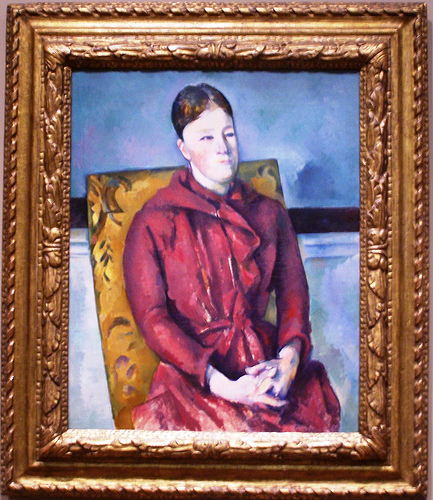
Paul Cezanne, Madame Cezanne in a Yellow Chair, 1888-90

***

Here’s what’s on its right.

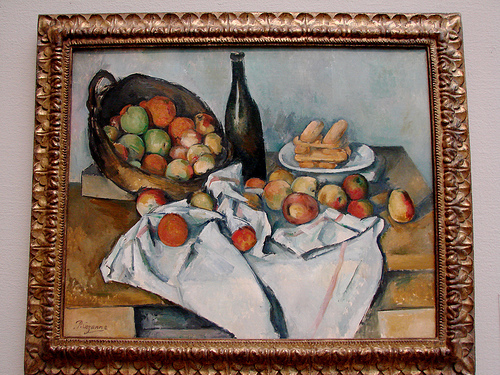
Paul Cezanne, The Basket of Apples, c. 1893

***

And here’s what’s on the adjacent wall.

Paul Cezanne, Harlequin, 1888-90
(on loan from the National Gallery of Art, Washington, D.C.)

***

I still work with difficulty, but I seem to get along. That is the important thing to me. Sensations form the foundation of my work, and they are imperishable, I think. Moreover, I am getting rid of that devil who, as you know, used to stand behind me and forced me at will to “imitate”; he’s not even dangerous any more.

—Paul Cezanne (last letter to his son Paul, dated October 15, 1906, a week before his death; quoted in Ambroise Vollard, Cezanne)

*****

Art ______ of Chicago

In the department of duh, after decades of going there and decades of listening to them, I’ve just noticed the verbal similarity between the Art Institute of Chicago and the Art Ensemble of Chicago.

Friday, 4/22/11

Happy (89th) Birthday, Mingus!

Charles Mingus, bassist, bandleader, composer
April 22, 1922-January 5, 1979

In celebration of Mingus’s birthday, WKCR-FM (broadcasting from Columbia University) is playing his music all day. We’re celebrating by revisiting some favorite clips.

**********

Duke Ellington, Count Basie, Miles Davis: so many of the greatest figures in jazz weren’t just great musicians, or composers, or arrangers. They were great bandleaders. As important to their artistic success as anything else was their ability to find, and showcase, players who could make the music come alive—people like Johnny Hodges and Ben Webster and Jimmy Blanton and Lester Young and Freddie Green and Jo Jones and John Coltrane and Bill Evans and Tony Williams.

That small circle of elite bandleaders includes this man. He hired musicians who played their instruments like no one else (Eric Dolphy, Jaki Byard, et al.). He gave them a musical setting in which structure and freedom were exquisitely balanced. And together they made music that sounds (even on something familiar) like nothing else.

Charles Mingus Sextet (with Johnny Coles, trumpet; Jaki Byard, piano; Eric Dolphy, alto saxophone and bass clarinet; Clifford Jordan, tenor saxophone; Dannie Richmond, drums), “Take the A Train,” live, Norway (Oslo), 1964

**********

lagniappe

I nominate Charles Mingus one of America’s greatest composers—Ran Blake (in the liner notes to his recent album Driftwoods)

(Originally posted 12/1/09.)

**********

No jazz composer since Thelonious Monk has a stronger voice.

Lyrical beauty, inexhaustible drive, deep feeling: what more could you ask for?

Enormously influential, his music served as a bridge between the compositional elegance of Duke Ellington and the freewheeling rambunctiousness of the Art Ensemble of Chicago, Henry Threadgill, David Murray, et al.

Charles Mingus Quintet (CM, bass; Dannie Richmond, drums; Eric Dolphy, alto saxophone, bass clarinet; Clifford Jordan, tenor saxophone; Jaki Byard, piano), live (TV broadcast), Belgium, 1964

“So Long, Eric”

*****

“Peggy’s Blue Skylight”

*****

“Meditations on Integration” (excerpt)

**********

lagniappe

. . . [Mingus’s] music was pledged to the abolition of all distinctions: between the composed and the improvised, the primitive and the sophisticated, the rough and the tender, the belligerent and the lyrical.—Geoff Dyer, But Beautiful: A Book About Jazz (1996)

*****

Making the simple complicated is commonplace; making the complicated simple, awesomely simple, that’s creativity.

***

I, myself, came to enjoy the players who didn’t only just swing but who invented new rhythmic patterns, along with new melodic concepts. And those people are: Art Tatum, Bud Powell, Max Roach, Sonny Rollins, Lester Young, Dizzy Gillespie and Charles Parker, who is the greatest genius of all to me because he changed the whole era around.

***

In my music, I’m trying to play the truth of what I am. The reason it’s difficult is because I’m changing all the time.

—Charles Mingus

(Originally posted 4/22/10.)

Saturday, 4/9/11

If you’re away from home, how good it is to find a musical sanctuary, as I have the last two Fridays at Harvard’s Paine Concert Hall; last night I heard this string quartet play, wonderfully, music by Brahms and two contemporary composers (Adam Roberts, James Yannatos).

Chiara Quartet, Jefferson Friedman: String Quartet No. 2 (excerpt)
Live, New York (Le Poisson Rouge), 2010

Vodpod videos no longer available.

Are we ever better—more focused, more receptive, more supple—than when we’re listening to live music?

**********

lagniappe

art beat

Edward Hopper, Room in Brooklyn (1932), Museum of Fine Arts, Boston

Wednesday, 4/6/11

I’m surprised that I got this old and know so little.

—Terry Riley

Terry Riley, talking and playing, California, 2010

Vodpod videos no longer available.

*****

In C (excerpt), Terry Riley, 1964

Take 1

Terry Riley, Center of Creative and Performing Arts (SUNY-Buffalo), 1968

Vodpod videos no longer available.

***

Take 2

Ars Nova, Percurama Percussion Ensemble, Paul Hillier (cond.), 2007

Vodpod videos no longer available.

**********

lagniappe

art beat: yesterday at Boston’s Museum of Fine Arts

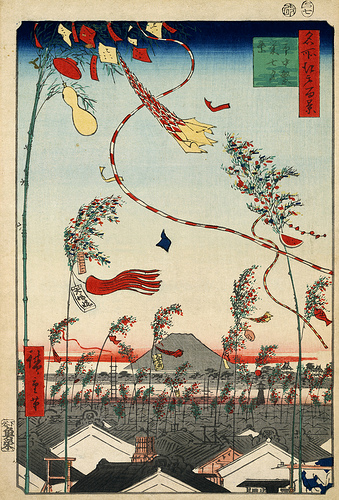
Hiroshige, The City Flourishing, Tanabata Festival (1857)


Wednesday, 3/30/11

I find it hard to understand why some folks wall themselves off from classical music. Jazz, blues, rock, classical: it’s all music. Sure, the musical lines and paragraphs—the units of expression—are usually (though not always) longer and more complex in classical music. But that’s simply a matter of form. Raymond Carver and Marcel Proust, for all their formal differences, both take you places you can’t get to any other way. So too do both Beethoven and Art Pepper, both Magic Sam and Mozart.

Bela Bartok, String Quartet No. 1 in A minor, 3rd movement
The Parker Quartet, live, 11/23/09

Vodpod videos no longer available.

Thursday, 3/17/11

two takes

Mozart was a kind of idol to me—this rapturous singing . . . that’s always on the edge of sadness and melancholy and disappointment and heartbreak, but always ready for an outburst of the most delicious music.

Saul Bellow

Mozart, Quintet for Clarinet and Strings in A major, K. 581 (1789)
2nd Movement (Larghetto)

Bruce Nolan (clarinet) and the Sierra String Quartet

Vodpod videos no longer available.

***

Yona Ettlinger (clarinet) and the Tel Aviv Quartet

Vodpod videos no longer available.

More? Here. And here. And here.

Thursday, 3/3/11

You have no idea one moment what’s going to happen the next (assuming, that is, you’re not following the score).

This can be disorienting, or exhilarating, or both.

Milton Babbitt (1916-2011), Composition for Four Instruments (flute, clarinet, violin, cello; 1948)

Vodpod videos no longer available.

More? Here.

**********

lagniappe

musical thoughts

Babbit was not quite as difficult as he seemed. He may have been dealing in abstruse relationships among myriad elements, but his listeners didn’t have to digest too many at once. From Webern, Babbit learned the art of deriving a set from successive transformations of a group of just three notes (“trichord”), which becomes a microcosm of the series. With these tiny motives in play, the texture tends to be less complicated than in the average post-Schoenbergian work. Composition for Four Instruments gives the impression of economy, delicacy, and extreme clarity; flute, clarinet, violin, and cello play solos, duets, and trios, coming together as a quartet only in the final section, and even there the ensemble dissolves into softly questing solo voices at the end. Thick dissonances are rare; like Japanese drawings, Babbitt’s scores are full of empty space.

—Alex Ross, The Rest Is Noise (2007)

***

There was only one.  There were no “simultaneities” in this particular musical equation. Milton Byron Babbitt stands alone.  He will never be popular. Nor will he cease to inspire.

Ethan Iverson (The Bad Plus)

Wednesday, 3/2/11

sorrowful, adj. showing or expressing sorrow; mournful; plaintive.
E.g., Roger Sessions’ Duo for Violin and Piano.

Roger Sessions (1896-1985), Duo for Violin and Piano (1942), excerpts
Carlos Bernales, violin, Chris Christopher, live, New York, 2/1/08

#1

Vodpod videos no longer available.

***

#2

Vodpod videos no longer available.

***

#3

Vodpod videos no longer available.

Monday, 2/14/11

Spontaneity, immediacy, freshness—they can be as important in classical music as they are in jazz. What I love about this performance, for instance, is that he never stops searching. It’s as if he’s encountering this piece for the first time and unable to conceal his astonishment.

Beethoven, Piano Sonata No. 31, Op. 110/Rudolf Serkin, piano, live, 1987

1st Movement

Vodpod videos no longer available.

***

2nd Movement

Vodpod videos no longer available.

***

3rd Movement

Vodpod videos no longer available.

More Beethoven piano sonatas?

Here (No. 14, “Moonlight,” Artur Schnabel).

And here (No. 21, “Waldstein,” Emil Gilels).

And here (No. 23, “Appassionata,” Solomon).

And here. (No. 32, Claudio Arrau).

**********

lagniappe

reading table

The Busy Road

I am so used to it by now
that when the traffic falls silent,
I think a storm is coming.

***

Lonely

No one is calling me. I can’t check the answering machine because I have been here all this time. If I go out, someone may call while I’m out. Then I can check the answering machine when I come back in.

***

Nietszche

Oh, poor Dad. I’m sorry I made fun of you.
Now I’m spelling Nietszche wrong, too.

The Collected Stories of Lydia Davis (2009)