music clip of the day

jazz/blues/rock/classical/gospel/more

Category: classical

Saturday, 9/10/11

lucid, adj. suffused with light, luminous. E.g., Morton Feldman’s Piano and String Quartet.

Morton Feldman, Piano and String Quartet (1985)
Kronos Quartet with Aki Takahashi (piano)

Vodpod videos no longer available.

In a world that keeps getting faster and noisier, Feldman offers a refuge.
Here time slows. Quietly.

More? Here. And here. And here. And here. And here.

Sunday, 9/4/11

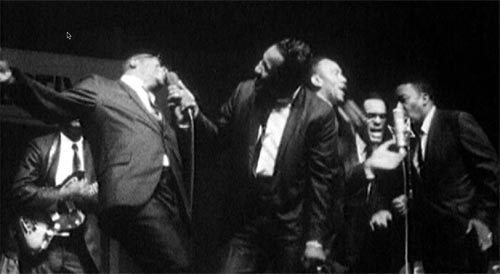
The Dixie Hummingbirds (with Ira Tucker, lead vocals), “If You See My Savior” (T. Dorsey), live (TV broadcast), early 1960s

With a voice like this, who needs words?

(Listen, for instance, at :55 and 1:50.)

More? Here.

**********

lagniappe

listening room: (some of) what’s playing

Theo Parrish, Sound Sculptures Vol. 1 (Sound Signature)

• Various artists, Goodbye Babylon (Dust-to-Digital)

Sun Ra, Jazz in Silhouette (Evidence)

Anthony Braxton, For Alto (Delmark)

Fred Anderson, Timeless (Delmark)

• Bach, Suites for Unaccompanied Cello/Steven Isserlis (Hyperion UK [import])

• Alfred Schnittke, Piano Quintet, String Trio, etc. (Naxos)

• Morton Feldman, For Bunita Marcus, Stephane Ginsburgh, piano (Sub Rosa) (available as a download from Amazon for 89¢)

• WKCR-FM (broadcasting from Columbia University)
—Lester Young/Charlie Parker birthday marathon
Bird Flight (Phil Schaap, jazz [Charlie Parker])
Eastern Standard Time (Carter Van Pelt, Jamaican music)

• WFMU-FM
Mudd Up! (DJ/Rupture“new bass and beats”)
Sinner’s Crossroads 
(Kevin Nutt, gospel)


Tuesday, 8/23/11

From the streets of New Orleans to the parks of New York.

John Luther Adams, Inuksuit (2009)

Take 2: Live (excerpts), New York (Morningside Park), 6/21/11

#1

Vodpod videos no longer available.

***
#2

Vodpod videos no longer available.

Take 1? Here.

**********

lagniappe

The Miller Theater made a mighty contribution to the daylong festival Make Music New York on Tuesday in the form of an expansive 80-minute performance of John Luther Adams’s “Inuksuit” (2009). Mr. Adams, who lives in Alaska, conceived this elastic percussion work as an outdoor piece for 9 to 99 players, and Melissa Smey, the theater’s director, went for the maximum, commandeering Morningside Park and inviting the percussion virtuoso Doug Perkins to lead a mega-ensemble that included So Percussion, the Percussion Group Cincinnati, the Proper Glue Duo, Mantra Percussion and students from music schools around the country.

Listeners walking through the park before 5 p.m. found small arrays of unattended drums, cymbals, xylophones and other instruments stationed along the park’s stairs and walkways, and conch shells, paper cones and rubber tubes scattered around the lawn where the performance was to begin. At 5, the 99 percussionists filed into the field, retrieved the smaller instruments and started the performance with gentle windlike sounds. They added graceful, eerie tones and harmonies by swinging the rubber tubes at various velocities; and they used sandpaper blocks and frame drums filled with bottle caps to create texture.

Gradually, the players dispersed through the park, making their way to the drum arrays. Your experience of the piece depended on where you were in the park, and most people walked around. (At one point I flipped a coin to choose which path to take.) But wherever you were, bursts of sound — loud, quiet, hard, soft — surrounded you.

There were sounds Mr. Adams may not have counted on. Birds and aircraft made their own contributions, as did camera shutters: at any moment, just about every player was being photographed by two or more listeners. And near the end of the piece, when the sounds were mostly the tactile ringing of xylophones and triangles, an ice cream truck added its cheerful melody to the mix (presumably not by design). But through the entire performance, I did not hear a single cellphone ring.

—Allan Kozinn, New York Times, 6/26/11

*****

reading table

An odd planet, and those on it are odd, too.
They’re subject to time, but they won’t admit it.
They have their own ways of expressing protest.
They make up little pictures, like for instance this:

At first glance, nothing special.
What you see is water.
And one of its banks.
And a little boat sailing strenuously upstream.
And a bridge over the water, and people on the bridge.
It appears that the people are picking up their pace
because of the rain just beginning to lash down
from a dark cloud.

The thing is, nothing else happens.
The cloud doesn’t change its color or its shape.
The rain doesn’t increase or subside.
The boat sails on without moving.
The people on the bridge are running now
exactly where they ran before.

It’s difficult at this point to keep from commenting.
This picture is by no means innocent.
Time has been stopped here.
Its laws are no longer consulted.
It has been relieved of its influence over the course of events.
It has been ignored and insulted.

On account of a rebel,
one Hiroshige Utagawa
(a being who, by the way,
died long ago and in due course),
time has tripped and fallen down.

It might well be simply a trifling prank,
an antic on the scale of just a couple of galaxies,
let us, however, just in case,
add one final comment for the record:

For generations, it’s been considered good form here
to think highly of this picture,
to be entranced and moved.

There are those for whom even this is not enough.
They go so far as to hear the rain’s spatter,
to feel the cold drops on their necks and backs,
they look at the bridge and the people on it
as if they saw themselves there,
running the same never-to-be-finished race
through the same endless, ever-to-be-covered distance,
and they have the nerve to believe
that this is really so.

—Wislawa Szymborska, “The People on the Bridge” (trans. Clare Cavanagh & Stanislaw Baranczak)

***

 Utagawa Hiroshige (1797-1858), The Landscape

*****

700 posts?

Yep.
Tuesday, 8/2/11

how to improve your life (guaranteed!)

Listen, each day, to one of Bach’s six suites for unaccompanied cello. I’ve been listening to them for 40 years. If I hadn’t, I assure you, my life would be even more of a shambles.

Bach, Suite No. 3 in C major for Unaccompanied Cello
Jean-Guihen Queyras, cello

Vodpod videos no longer available.

More? Here. And here.

**********

lagniappe

reading table

I am who I am.
A coincidence no less unthinkable
than any other.

I could have different
ancestors, after all.
I could have fluttered
from another nest
or crawled bescaled
from another tree.

Nature’s wardrobe
holds a fair supply of costumes:
spider, seagull, fieldmouse.
Each fits perfectly right off
and is dutifully worn
into shreds.

I didn’t get a choice either,
but I can’t complain.
I could have been someone
much less separate.
Someone from an anthill, shoal, or buzzing swarm,
an inch of landscape ruffled by the wind.

Someone much less fortunate,
bred for my fur
or Christmas dinner,
something swimming under a square of glass.

A tree rooted to the ground
as the fire draws near.

A grass blade trampled by a stampede
of incomprehensible events.

A shady type whose darkness
dazzled some.

What if I’d prompted only fear,
loathing,
or pity?

If I’d been born
in the wrong tribe
with all roads closed before me?

Fate has been kind
to me thus far.

I might never have been given
the memory of happy moments.

My yen for comparison
might have been taken away.

I might have been myself minus amazement,
that is,
someone completely different.

—Wislawa Szymborska, “Among the Multitudes” (trans. Clare Cavanagh & Stanislaw Baranczak)

More? Here. And here.

Saturday, 7/30/11

The four familial instruments seem to whisper directly into our ears, communing with us about our personal sadnesses and anxieties.

—Wendy Lesser, Music For Silenced Voices: Shostakovich and His Fifteen Quartets (2011)

Dmitri Shostakovich, String Quartet No. 14 in F-Sharp Major (1972-73)
Fitzwilliam String Quartet

1st Movement (Allegretto)

Vodpod videos no longer available.

***

2nd Movement (Adagio)

Vodpod videos no longer available.

***

3rd Movement (Allegretto)

Vodpod videos no longer available.

More? Here.

**********

lagniappe

musical thoughts

I think he [President Obama] needs to listen to some jazz. Maybe the entire capital needs it to calm down.

—Chicago Mayor Rahm Emanuel, 7/28/11

Thursday, 7/21/11

Time for just one?

I’d go with Alfred Cortot.

*****

favorites
(an occasional series)

Of beauty you cannot have too much.

Frederic Chopin, Ballade No. 1 in G minor, Op. 23 (1835-36)

Take 1: Vladimir Horowitz, live, New York (Carnegie Hall)

Vodpod videos no longer available.

*****

Take 2: Krystian Zimerman, live

Vodpod videos no longer available.

*****

Take 3: Claudio Arrau

Vodpod videos no longer available.

*****

Take 4: Alfred Cortot

Vodpod videos no longer available.

*****

Take 5: Sviatoslav Richter, live (Kiev)

Vodpod videos no longer available.

More Chopin? Here. And here. And here.

**********

lagniappe

musical thoughts

[T]he things we feel in life are not experienced in the form of ideas, and so their translation into literature, an intellectual process, may give an account of them, explain them, analyse them, but cannot recreate them as music does, its sounds seeming to take on the inflections of our being, to reproduce that inner, extreme point of sensation which is that thing that causes us the specific ecstasy we feel from time to time and which, when we say ‘What a beautiful day! What beautiful sunshine!’, is not conveyed at all to our neighbour, in whom the same sun and the same weather set off quite different vibrations.

—Marcel Proust, The Prisoner (1925), trans. Carol Clark

(Originally posted 12/27/10.)

Tuesday, 7/19/11

Don’t bother with this if you’re too busy to be mesmerized.

Bach, The Art of the Fugue (excerpt)/Glenn Gould, piano

Vodpod videos no longer available.

More? Here. And here.

Thursday, 7/14/11

two takes

Arvo Pärt, Cantus in Memoriam Benjamin Britten (1977)

A Far Cry, live, Boston (Jordan Hall), 10/17/08

Vodpod videos no longer available.

***

BBC Symphony Orchestra, live, London (Royal Albert Hall), 8/17/10

Vodpod videos no longer available.

This goes, and goes, and goes, keeping you afloat, carrying you along,
then stops with stunning suddenness—is any music more lifelike?

Tuesday, 7/12/11

John Luther Adams, Inuksuit (excerpt)
New York (Park Avenue Armory), 2/20/11

Vodpod videos no longer available.

More? Here.

**********

lagniappe

Scored for a flexible ensemble of between nine and ninety-nine percussionists, “Inuksuit” is intended for outdoor performance, and it had its première on a mountainside in Banff, Canada, in 2009. Adams at first resisted the idea of taking the piece indoors, because the interaction with nature was integral to his conception. After inspecting the Armory, though, he grasped its possibilities; the space is more a man-made canyon than a concert hall. He settled on a corps of seventy-six musicians, including five piccolo players. Arrays of drums, gongs, cymbals, bells, and numerous smaller instruments were set up on the main floor of the Drill Hall; atop catwalks on all sides; and in the hallways that connect to smaller rooms at the front of the building. In any rendition of “Inuksuit,” the performers are given four or five pages of music—the notation imitates the shapes of the Inuit markers—which they execute at their own pace. Musicians with portable instruments are instructed to move about freely. Prearranged signals prompt a move from one page to the next. The result is a composition that on the microcosmic level seems spontaneous, even chaotic, but that gathers itself into a grand, almost symphonic structure.

At 4 P.M. on a Sunday, thirteen hundred people assembled in the Drill Hall to hear the piece, variously standing, sitting, or lying on the floor. First came an awakening murmur: one group of performers exhaled through horns and cones; others rubbed stones together and made whistling sounds by whirling tubes. Then one member of the ensemble—Schick, perched above the entrance to the Drill Hall—delivered a call on a conch shell. With that commanding, shofar-like tone, the sound started to swell: tom-toms and bass drums thudded, cymbals and tam-tams crashed, sirens wailed, bells clanged. It was an engulfing, complexly layered noise, one that seemed almost to force the listeners into motion, and the crowd fanned out through the arena.

***

It is tricky to write about an event such as this. Because both ensemble and audience were in motion, no two perceptions of the performance were the same, and no definitive record of it can exist. Furthermore, anyone who ventures to declare in a public forum that “Inuksuit” was one of the most rapturous experiences of his listening life—that is how I felt, and I wasn’t the only one—might be suspected of harboring hippie-dippie tendencies. The work is not explicitly political, nor is it the formal expression of an individual sensibility, although John Luther Adams certainly deserved the ecstatic and prolonged ovation that greeted him when he acknowledged the crowd from the center of the Drill Hall. In the end, several young couples seemed to deliver the most incisive commentary when, amid the obliterating tidal wave of sound, they began making out.

—Alex Ross, New Yorker, 3/14/11

*****

Happy Birthday, Suzanne!

As I mentioned on this date last year, the first time my wife Suzanne and I went out together (September 1974, Chicago’s Jazz Showcase), we saw the man who put the sui in sui generis.

Sun Ra, Space Is the Place (1974), excerpt

Vodpod videos no longer available.

More? Here. And here.

*****

speaking of birthdays

How often do you get to say “Happy 100th Birthday”?

Well, here’s your chance.

As I learned the other day from WKCR-FM’s Phil Schaap, who’s been encouraging folks to send this guy a birthday card (I mailed mine yesterday), the oldest performing jazz musician, trumpeter Lionel Ferbos, who plays at New Orleans’ Palm Court Jazz Cafe, turns 100 on July 17th. Birthday greetings can be mailed (remember mail?) to 5543 Press Dr., New Orleans, LA 70126.

Thursday, 6/30/11

two questions

1. Why would anyone create a piece of music that lasts not one, or two, or three, or four, or five, but six hours?

2. Why don’t more more people?

Morton Feldman, String Quartet No. 2 (1983), excerpts, Flux Quartet

***

On June 12th the Flux Quartet performed this piece in Philadelphia, the finale of American Sublime, a festival devoted to Feldman’s late music. The concert, which took place in the sanctuary of Philadelphia Cathedral, began at 2 p.m.; it ended around 8 p.m. The program notes said: “Audience may come and go as they please.”

More? Here. And here. And here. And here. And here.

**********

lagniappe

this & that

I don’t win stuff. I don’t even enter things—contests, sweepstakes, lotteries—that would give me a shot at winning stuff. Until yesterday, that is.

Yesterday morning, driving home after dropping my son Luke off at work (7 a.m. can be a pretty brutal starting time for a 20-year-old), I was listening, as I often do while driving, to our local public radio station (WBEZ-FM), which, I learned, was in the midst of a fundraising drive. “Pledge,” they said, and “you’ll be entered in drawings for an iPad 2,” which were going to be made throughout the day. The earlier you pledge, they said, with what seemed unassailable logic, the better your chances of winning. I hadn’t sent them any money in a while so, when I got home, I went on-line and pledged. A couple hours later, a friend sent me an email: “Congratulations on your iPad.”

When bad stuff happens, particularly bad stuff that’s unexpected and outside my control (as often seems to be the case), my tendency is to try to let it go. Why invest bad experiences with ill-fitting, after-the-fact meanings? This is different. This experience I’d like to invest with all kinds of after-the-fact-meanings, ill-fitting or not. I’d like to see this as a favorable omen, one that portends all sorts of wonderful stuff—things that, at the moment, I can’t even begin to imagine. Goofy? Yeah, I suppose. But is it any nuttier than any number of other stories we tell ourselves to get us through the day?