Thursday, 2/16/12
Some music creates a space so mysterious—so different from what you ordinarily inhabit—that the moment it ends you feel bereft.
Toru Takemitsu (1930-1996), Rain Tree, Line C3, New York, 2011
Vodpod videos no longer available.
Some music creates a space so mysterious—so different from what you ordinarily inhabit—that the moment it ends you feel bereft.
Toru Takemitsu (1930-1996), Rain Tree, Line C3, New York, 2011
Vodpod videos no longer available.
Morton Feldman, For Bunita Marcus (1985)
John Tilbury, piano
According to iTunes, I’ve listened to this piece, which I often put on “repeat” before going to sleep, over a thousand times.
***
More Feldman?
And here.
And here.
**********
lagniappe
musical thoughts
Compositionally I always wanted to be like Fred Astaire.
***
I never feel that my music is sparse or minimal; the way fat people never really think they’re fat. I certainly don’t consider myself a minimalist at all.
***
No one has the Houdini school of composition.
*****
reading table
Last week a record store in Dupont Circle announced that it was closing. The immediate cause of its demise—it had outlasted national and regional chains—was Price Check, Amazon’s new idea for exterminating competition. It is an app that allows shoppers to scan the bar code on any item in any store and transmit it to Amazon for purposes of comparison, and if it compares favorably to Amazon’s price, Amazon’s special promotion promises a discount on the same item. In this way shoppers become spies, and stores, merely by letting customers through their doors, become complicit in their own undoing. It will not do to shrug that this is capitalism, because it is a particular kind of capitalism: the kind that entertains fantasies of monopoly. For all its technological newness, Amazon’s “vision” is disgustingly familiar. (“Amazon is coming to eat me,” a small publisher of fine religious books stoically told me a few weeks ago.) Nor will it do to explain that Amazon’s app is convenient, unless one is prepared to acquiesce in a view of American existence according to which its supreme consideration must be convenience. How easy must every little thing be? A record store in your neighborhood is also convenient, and so is a bookstore. There is also a sinister side to the convenience of online shopping: hours once spent in the sensory world, in the diversified satisfaction of material needs and desires, can now be surrendered to work. It appears to be a law of American life that there shall be no respite from screens. And so Amazon’s practices raise the old question of the cultural consequences of market piggishness. For there are businesses that are not only businesses, that also have non-monetary reasons for being, that are public goods. Their devastation in the name of profit may be economically legitimate, but it is culturally calamitous. In a word, wrong.
WHEN MY FRIEND at Melody Records told me about the death of his store, I was bereft. This was in part because he is my friend—after my father died, I received a letter from the Holocaust Museum informing me that he had made a donation in my father’s memory—and now he must fend for himself and his family and his staff in the American wreckage. But my dejection was owed also to the fact that this store was one of the primary scenes of my personal cultivation. For thirty years it stimulated me, and provided a sanctuary from sadness and sterility. “Going to Melody” was a reliable way of improving my mind’s weather. The people who worked there had knowledge and taste: they apprised me of obscure pressings of Frank Martin’s chamber music, and warned me about the sound quality of certain reissues of Lucky Thompson and Don Byas, and turned me on to old salsa and new fado. They even teased me about my insane affection for Rihanna. When they added DVDs to the store, my pleasures multiplied. (Also my amusements. Not long ago Marcel Ophuls’ great film arrived in the shop, and the box declared: “Woody Allen presents The Sorrow and The Pity.” Beat that.) Of course all these discs can be found online. But the motive of my visits to the store was not acquisitiveness, it was inquisitiveness. I went there to engage in the time-honored intellectual and cultural activity known as browsing.
IT IS A MATTER OF some importance that the nature of browsing be properly understood. Browsing is a method of humanistic education. It gathers not information but impressions, and refines them by brief (but longer than 29 seconds!) immersions in sound or language. Browsing is to Amazon what flaneurie is to Google Earth. It is an immediate encounter with the actual object of curiosity. The browser (no, not that one) is the flaneur in a room. Browsing is not idleness; or rather, it is active idleness—an exploring capacity, a kind of questing non-instrumental behavior. Browsing is the opposite of “search.” Search is precise, browsing is imprecise. When you search, you find what you were looking for; when you browse, you find what you were not looking for. Search corrects your knowledge, browsing corrects your ignorance. Search narrows, browsing enlarges. It does so by means of accidents, of unexpected adjacencies and improbable associations. On Amazon, by contrast, there are no accidents. Its adjacencies are expected and its associations are probable, because it is programmed for precedents. It takes you to where you have already been—to what you have already bought or thought of buying, and to similar things. It sells similarities. After all, serendipity is a poor business model. But serendipity is how the spirit is renewed; and a record store, like a bookstore, is nothing less than an institution of spiritual renewal.
—Leon Wieseltier, “Going To Melody,” The New Republic, 2/2/12
When I retire, I’m going to move to 19th century Paris. I’ll have a thirty-something mistress. And drink café au lait.
Frederic Chopin, 24 Preludes, Excerpt (1-7)
Maurizio Pollini, piano
Japan, 1982
**********
lagniappe
At last I have come into a dreamland.
—Harriet Beecher Stowe, in 1853, after arriving in Paris
*****
Want more? Here are the rest.
8-14
***
15-19
***
20-24
Ever feel like you’re drowning in dreck?
Me, too.
When that happens, this is one of the things I turn to—it never fails.
Johann Sebastian Bach, Suite No. 3 in C major for Unaccompanied Cello, 4th Mvt. (Sarabande); Pierre Fournier (1906-1986), cello
**********
lagniappe
reading table
[O]ld age is a ceremony of losses, which is on the whole preferable to dying at forty-seven or fifty-two.
***
After a life of loving the old, by natural law I turned old myself. Decades followed each other—thirty was terrifying, forty I never noticed because I was drunk, fifty was best with a total change of life, sixty extended the bliss of fifty—and then came my cancers, Jane’s death, and over the years I travelled to another universe. However alert we are, however much we think we know what will happen, antiquity remains an unknown, unanticipated galaxy. It is alien, and old people are a separate form of life. They have green skin, with two heads that sprout antennae. They can be pleasant, they can be annoying—in the supermarket, these old old ladies won’t get out of my way—but most important they are permanently other. When we turn eighty, we understand that we are extraterrestrial. If we forget for a moment that we are old, we are reminded when we try to stand up, or when we encounter someone young, who appears to observe green skin, extra heads, and protuberances.
***
Whatever the season, I watch the barn. I see it through this snow in January, and in August I will gaze at trailing vines of roses on a trellis against the vertical boards. I watch at the height of summer and when darkness comes early in November. From my chair I look at the west side, a gorgeous amber laved by the setting sun, as rich to the eyes as the darkening sweet of bees’ honey. . . . Out the window, I watch a white landscape that turns pale green, dark green, yellow and red, brown again under bare branches, until snow falls again.
—Donald Hall, “Out the Window,” New Yorker, 1/23/12
If you wanted to conjure a world full of mystery, what better instrument to lead the way than one that possesses neither the brightness of the violin nor the darkness of the cello?
Morton Feldman, Rothko Chapel (1971), live, Houston (Rothko Chapel), 2011; Kim Kashkashian (viola), Brian Del Signore (percussion), Sarah Rothenberg (celeste), Maureen Broy Papovich (soprano), Houston Chamber Choir (Robert Simpson, cond.)
Part 1
***
Part 2
***
Part 3
Another take? Here.
**********
lagniappe
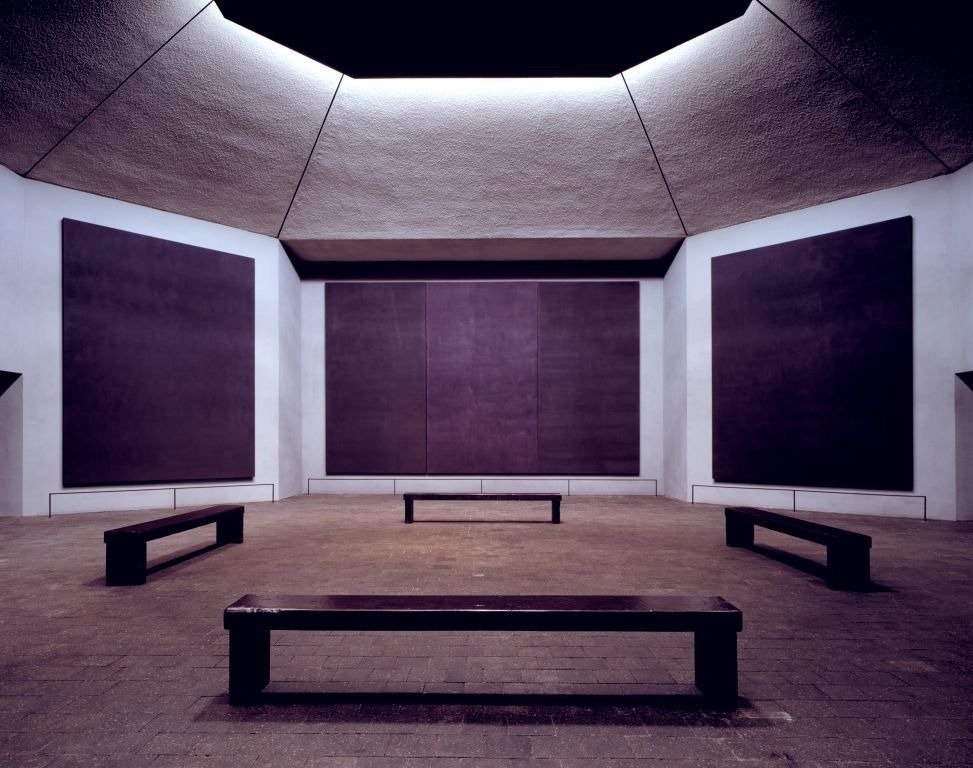
Rothko Chapel, Houston, Texas
***
The Rothko Chapel is an interfaith sanctuary, a center for human rights — and a one-man art museum devoted to 14 monumental paintings by abstract expressionist Mark Rothko. The Houston landmark, commissioned by John and Dominique de Menil, opened its doors 40 years ago, in February 1971.
For the past four decades, the chapel has encouraged cooperation between people of all faiths — or of no faith at all. While the chapel itself has become an art landmark and a center for human-rights action, the sanctuary’s creator never lived to see it finished. Rothko committed suicide in 1970.
Approaching the chapel from the south, visitors first see a steel sculpture called Broken Obelisk by Barnett Newman in the middle of a pool — it appears to be floating on the surface of the water. The chapel itself is a windowless, octagonal brick building. Solid black doors open on a tiny glass-walled foyer. (The foyer was walled off from the rest of the interior when the Gulf Coast’s notorious humidity began to affect the paintings.)
The main room is a hushed octagonal space with gray stucco walls, each filled by massive paintings. Some walls feature one canvas, while on others, three canvases hang side by side to form a triptych. A baffled skylight subdues the bright Houston sun, and the surfaces of the paintings change dramatically as unseen clouds pass outside. There are eight austere wooden benches informally arranged, and today, a few meditation mats. A young woman brings the meditation hour to a close by striking a small bowl with a mallet, creating a soft peal of three bells in the intense silence of the room.
Concerts, conferences, lectures, weddings and memorial services all take place in the chapel throughout the year, but on most days you will find visitors — about 55,000 annually come to see, to meditate, to write in the large comment book in the foyer, to read the variety of well-thumbed religious texts available on benches at the entrance.
***
These paintings do not feature the luminous color fields that made Rothko famous. The paintings in the chapel are dark, in purplish or black hues. And there’s a reason for that, says [chapel historian Suna] Umari.
“They’re sort of a window to beyond,” she explains. “He said the bright colors sort of stop your vision at the canvas, where dark colors go beyond. And definitely you’re looking at the beyond. You’re looking at the infinite.”
***
At first glance, the paintings appear to be made up of solid, dark colors. But look closely, and it becomes evident that the paintings are composed of many uneven washes of pigment that create variations in every inch. Stepping back, waves of subtle color difference appear across the broad surfaces — leading to an unmistakable impression of physical depth.
***
Though Mark Rothko didn’t live to see the sanctuary he created, Christopher Rothko says his father knew what it should be.
“It took me a while to realize it, but that’s really my father’s gift, in a sense, to somebody who comes to the chapel. It’s a place that will really not just invite, but also demand a kind of journey.”
—Pat Dowell, “Meditation and Modern Art Meet In Rothko Chapel,” NPR, 3/1/11
*****
reading table
Our lives are Swiss –
So still – so Cool –
Till some odd afternoon
The Alps neglect their Curtains
And we look farther on!Italy stands the other side!
While like a guard between –
The solemn Alps –
The siren Alps
Forever intervene!—Emily Dickinson
What you want, sometimes, is to lose yourself, even if only briefly, in beauty.
Leo Janacek (1854-1928), String Quartet No. 1, “The Kreutzer Sonata,” excerpt (arr. Tognetti), Australian Chamber Orchestra
**********
lagniappe
random thoughts
When you’re young you want to find yourself; when you’re old you want to lose yourself.
*****
reading table
Variations for Two Pianos
for Thomas Higgins, pianist
by Donald Justice
There is no music now in all of Arkansas.
Higgins is gone, taking both his pianos.
Movers dismantled the instruments, away
Sped the vans. The first detour untuned the strings.
There is no music now in all of Arkansas.
Up Main Street, past the cold shopfronts of Conway,
The brash, self-important brick of the college,
Higgins is gone, taking both his pianos.
Warm evenings, the windows open, he would play
Something of Mozart’s for his pupils, the birds.
There is no music now in all of Arkansas.
How shall the mockingbird mend her trill, the jay
His eccentric attack, lacking a teacher?
Higgins is gone, taking both his pianos.
There is no music now in all of Arkansas.
more favorites from the past year
I sometimes feel as if I’m making my way, page by page, through a book titled The 10,000 Musical Performances You Must Hear Before You Die. Rarely does a week go by that I’m not astonished, at least once, by something I’ve never heard before. Yesterday it was this tiny gem.*
Sergei Prokofiev, Vision Fugitive No. 18, Con una dolce lentezza
Sviatoslav Richter (1915-1997), piano
*S. Richter, Richter Rediscovered: Carnegie Hall Recital 1960 (RCA)
(Originally posted 5/5/11.)
*******
Classical music would be better off if folks quit calling it “classical music.”
Arnold Schoenberg, Op. 19, Six Little Piano Pieces
Michel Beroff, piano, live
(Originally posted 6/23/11.)
John Coltrane, Dorothy Love Coates, this guy: the genre makes no difference; some folks play like (as Buddhists put it) their hair is on fire.
Bach, Partita No. 4 in D Major, BMV 828
Glenn Gould, live, Canada, 1981
1: Ouverture
***
2: Allemande
***
3: Courante
***
4: Aria
***
5: Sarabande
***
6: Menuet
***
7: Gigue
**********
lagniappe
heaven, n. a condition or place of great happiness, delight, or pleasure. E.g., WKCR-FM’s annual Bach Festival, which begins today, at 3 p.m., and runs until midnight New Year’s Eve.
La Monte Young, The Well-Tuned Piano
Part 1
***
Part 2
***
Part 3
***
Part 4
***
Part 5
**********
lagniappe
Minimalism proper begins with La Monte Young, the master of the drone. He was born in 1935 in a tiny dairy community in Idaho, and spent his childhood listening to the secret music of the wide-open landscape—the microtonal chords of power lines, the harsh tones of drills and lathes, the wailing of far-off trains, the buzzing songs of grasshoppers, the sound of the wind moving over Utah Lake and whistling through the cracks of his parents’ log cabin. In 1940 he moved to Los Angeles with his family. As he later said, he fell in love with California’s ‘sense of space, sense of time, sense of reverie, sense that things could take a long time, that there was always time.’
—Alex Ross, The Rest Is Noise: Listening to the Twentieth Century (2007)
Happy (Belated) 103rd Birthday, Elliott!
Elliott Carter, composer, December 11, 1908-
The other night I put this on, thinking I’d do something else while it played; but, as it turned out, “something else” had to wait.
String Quartet No. 2 (1959), Composers Quartet
**********
lagniappe
Juilliard String Quartet with Elliott Carter, 2008
Rehearsing String Quartet No. 5
*****
musical thoughts
Mr. Carter has written 15 new works since his 100th birthday.
—Allan Kozinn, New York Times, 12/13/11
***
Haydn, Beethoven, Schubert, Webern, Bartok, Shostakovich, Carter, et al.: you could spend the rest of your life listening to nothing but string quartets without ever feeling deprived.
 music clip of the day