music clip of the day

jazz/blues/rock/classical/gospel/more

Category: classical

Thursday, 4/26/12

Not even with all the fingers on all the hands of all the people in the city of Chicago could you count the possibilities offered by just three instruments.

Gyorgy Ligeti, Trio for Violin, Horn, and Piano (1982); Tomas Major (violin), Zora Sloka (horn), Denes Varjon (piano), 2009

Part 1

***

Part 2

**********

lagniappe

art beat: Sunday at the Art Institute of Chicago

Robert Rauschenberg, Short Circuit, 1955

Thursday, 4/19/12

This guy’s a rare bird. Long a respected concert pianist, he’s also become a notable writer, appearing recently in the New Yorker and the New York Times Sunday Book Review.

Jeremy Denk, piano
Charles Ives, Concord Sonata (excerpt [“The Alcotts”])
Live, New York, 2012

**********

lagniappe

reading table

My Ives addiction started one summer at music camp, at Mount Holyoke College. I was twenty and learning his Piano Trio. There’s an astounding moment in the Trio where the pianist goes off into a blur of sweet and sour notes around a B-flat-major chord. I knew the moment was important, but I wondered, was my sound too vague or too clear? (A recurring interpretative problem in Ives is discovering the ideal amount of muddle.) I was also puzzled about where this phrase was going. I’d been taught that phrases were supposed to go somewhere, yet this musical moment seemed serenely determined to wander nowhere.

—Jeremy Denk, “Flight of the Concord,” New Yorker, 2/6/12

*****

yesterday

After posting the Peter Brötzmann clip and the AOL headlines, I drove a hundred miles to see a client serving a life sentence at the Pontiac Correctional Center, then stopped at a nearby restaurant for a mid-afternoon lunch, where I overheard the cook ask a patron: “Did you see where that guy was killed by a swan?”

Saturday, 4/14/12

The keyboard is the stage on which the fingers dance.

Sviatoslav Richter, piano
TV performance (CBC, Toronto),* 1964

**********

lagniappe

reading table

even grass and vines
don’t part willingly . . .
lantern for the dead

—Kobayashi Issa, 1822 (translated from Japanese by David G. Lanoue)

*****

*Johannes Brahms, Intermezzo in E Minor, Op. 116, No. 5
Sergei Prokofiev, Sonata No. 2 in D Minor, Op. 14
Maurice Ravel, Jeux d’eauAlborada del gracioso

Thursday, 4/12/12

He plays Bach as if, at that moment, nothing in the world is more crucial.

Johann Sebastian Bach, Glenn Gould, piano*
TV performance, 1981

*****

*Here, courtesy of YouTube, is the program:

00:21 Die Kunst der Fuge BWV 1080: Contrapunctus I

Partita n.4 in D-dur BWV 828
05:11 I Ouverture
10:06 II Allemande
15:45 III Courante
18:52 IV Aria
20:07 V Sarabande
25:21 VI Menuett
26:41 VII Gigue

From “Wohltemperierten Klavier”:
28:10 Fuge in E-dur (II)
33:17 Fuge in Es-moll (II)
36:16 Praeludium & Fuge in A-dur (II)

38:52 Die Kunst der Fuge BVW 1080: Contrapunctus IV

(Some of this has been posted before, but not all of it and not in one continuous clip.)

Wednesday, 3/28/12

What better experience for playing with the Velvet Underground, whose mentor, Andy Warhol, once observed “the channels switch, but it’s all television,” than to appear on I’ve Got a Secret?

I’ve Got a Secret (Garry Moore, host; John Cale, guest), 1963

The piece he plays at the end, Vexations, was composed in the early 1890s by Erik Satie.

**********

lagniappe

MCOTD’s granddog, and muse, Roscoe

Tuesday, 3/13/12

Music doesn’t care who you are, where you come from, what you know. It asks only that you pay attention.

Stefan Wolpe (1902-1972), Piece in Three Parts for Piano and Sixteen Instruments (1961), Peter Serkin (piano), Chamber Music Society of Lincoln Center (Oliver Knussen, cond.)
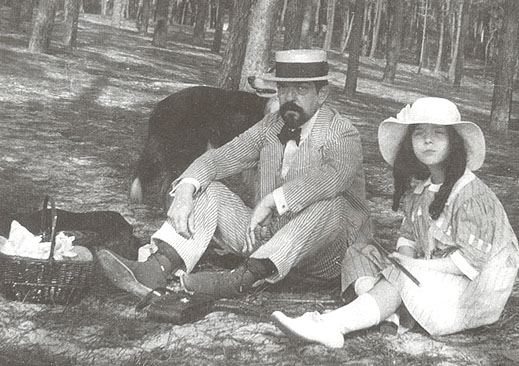
More? Here.

Thursday, 3/8/12

John Cage, Two (1987)

Live, Netherlands (Amsterdam), 2009
Dante Boon (piano), Rutger van Otterloo (soprano saxophone)

*****

Recording, 1991 (hat Art)
Marianne Schroeder (piano), Eberhard Blum (flute)

More? Here. And here.

**********

lagniappe

musical thoughts

Every something is an echo of nothing.

—John Cage, Silence (1961)

Thursday, 2/16/12

Some music creates a space so mysterious—so different from what you ordinarily inhabit—that the moment it ends you feel bereft.

Toru Takemitsu (1930-1996), Rain Tree, Line C3, New York, 2011

Vodpod videos no longer available.

Wednesday, 2/1/12

Morton Feldman, For Bunita Marcus (1985)
John Tilbury, piano

According to iTunes, I’ve listened to this piece, which I often put on “repeat” before going to sleep, over a thousand times.

***

More Feldman?

Here.

And here.

Here. 

And here. And here. And here.

Here. 

And here.

**********

lagniappe

musical thoughts

Compositionally I always wanted to be like Fred Astaire.

***

 I never feel that my music is sparse or minimal; the way fat people never really think they’re fat. I certainly don’t consider myself a minimalist at all.

***

No one has the Houdini school of composition.

Morton Feldman (1926-87)

*****

reading table

Last week a record store in Dupont Circle announced that it was closing. The immediate cause of its demise—it had outlasted national and regional chains—was Price Check, Amazon’s new idea for exterminating competition. It is an app that allows shoppers to scan the bar code on any item in any store and transmit it to Amazon for purposes of comparison, and if it compares favorably to Amazon’s price, Amazon’s special promotion promises a discount on the same item. In this way shoppers become spies, and stores, merely by letting customers through their doors, become complicit in their own undoing. It will not do to shrug that this is capitalism, because it is a particular kind of capitalism: the kind that entertains fantasies of monopoly. For all its technological newness, Amazon’s “vision” is disgustingly familiar. (“Amazon is coming to eat me,” a small publisher of fine religious books stoically told me a few weeks ago.) Nor will it do to explain that Amazon’s app is convenient, unless one is prepared to acquiesce in a view of American existence according to which its supreme consideration must be convenience. How easy must every little thing be? A record store in your neighborhood is also convenient, and so is a bookstore. There is also a sinister side to the convenience of online shopping: hours once spent in the sensory world, in the diversified satisfaction of material needs and desires, can now be surrendered to work. It appears to be a law of American life that there shall be no respite from screens. And so Amazon’s practices raise the old question of the cultural consequences of market piggishness. For there are businesses that are not only businesses, that also have non-monetary reasons for being, that are public goods. Their devastation in the name of profit may be economically legitimate, but it is culturally calamitous. In a word, wrong.

WHEN MY FRIEND at Melody Records told me about the death of his store, I was bereft. This was in part because he is my friend—after my father died, I received a letter from the Holocaust Museum informing me that he had made a donation in my father’s memory—and now he must fend for himself and his family and his staff in the American wreckage. But my dejection was owed also to the fact that this store was one of the primary scenes of my personal cultivation. For thirty years it stimulated me, and provided a sanctuary from sadness and sterility. “Going to Melody” was a reliable way of improving my mind’s weather. The people who worked there had knowledge and taste: they apprised me of obscure pressings of Frank Martin’s chamber music, and warned me about the sound quality of certain reissues of Lucky Thompson and Don Byas, and turned me on to old salsa and new fado. They even teased me about my insane affection for Rihanna. When they added DVDs to the store, my pleasures multiplied. (Also my amusements. Not long ago Marcel Ophuls’ great film arrived in the shop, and the box declared: “Woody Allen presents The Sorrow and The Pity.” Beat that.) Of course all these discs can be found online. But the motive of my visits to the store was not acquisitiveness, it was inquisitiveness. I went there to engage in the time-honored intellectual and cultural activity known as browsing.

IT IS A MATTER OF some importance that the nature of browsing be properly understood. Browsing is a method of humanistic education. It gathers not information but impressions, and refines them by brief (but longer than 29 seconds!) immersions in sound or language. Browsing is to Amazon what flaneurie is to Google Earth. It is an immediate encounter with the actual object of curiosity. The browser (no, not that one) is the flaneur in a room. Browsing is not idleness; or rather, it is active idleness—an exploring capacity, a kind of questing non-instrumental behavior. Browsing is the opposite of “search.” Search is precise, browsing is imprecise. When you search, you find what you were looking for; when you browse, you find what you were not looking for. Search corrects your knowledge, browsing corrects your ignorance. Search narrows, browsing enlarges. It does so by means of accidents, of unexpected adjacencies and improbable associations. On Amazon, by contrast, there are no accidents. Its adjacencies are expected and its associations are probable, because it is programmed for precedents. It takes you to where you have already been—to what you have already bought or thought of buying, and to similar things. It sells similarities. After all, serendipity is a poor business model. But serendipity is how the spirit is renewed; and a record store, like a bookstore, is nothing less than an institution of spiritual renewal.

—Leon Wieseltier, “Going To Melody,” The New Republic, 2/2/12

Saturday, 1/28/12

When I retire, I’m going to move to 19th century Paris. I’ll have a thirty-something mistress. And drink café au lait.

Frederic Chopin, 24 Preludes, Excerpt (1-7)
Maurizio Pollini, piano
Japan, 1982

**********

lagniappe

At last I have come into a dreamland.

—Harriet Beecher Stowe, in 1853, after arriving in Paris

*****

Want more? Here are the rest.

8-14

***

15-19

***

20-24