Kaija Saariaho, Fall (1991, from the ballet Maa); Nuiko Wadden (harp), Ryan Streber (electronics); Mount Holyoke College (South Hadley, Mass.), 2010
One of the joys of having grown children is going out with them to hear live music, as I did the other night, meeting my older son Alex after work at a Chicago art gallery (Corbett vs. Dempsey) for a solo performance by this harpist.
Anton Bruckner (1824-96), Symphony No. 5 in B flat major; Berlin Philharmonic (Wilhelm Furtwangler, cond.), live, Berlin, 1942
(Yeah, I realize this performance took place in Nazi Germany during World War II and, no, I don’t have anything profound, or even interesting, to say about how such beauty and such horror could coexist.)
Anton Bruckner (1824-96), Symphony No. 8 in C minor; Vienna Philharmonic (Herbert von Karajan, cond.), live, Austria (Abbey of St. Florian), 1979
**********
lagniappe
musical thoughts
Once upon a time, before the human attention span began to shrink, people could actually sit still and pay attention to something—a single thing—for over an hour.
John Cage, composer, September 5, 1912-August 12, 1992
Today, celebrating his centennial, we revisit past clips.
*****
10/9/09
No matter where you are, this landscape is just around the corner.
John Cage (1912-1992), In a Landscape (1948); Stephen Drury, piano
**********
lagniappe
musical thoughts
Music is a means of rapid transportation.
***
What I’m proposing, to myself and other people, is what I often call the tourist attitude—that you act as though you’ve never been there before. So that you’re not supposed to know anything about it. If you really get down to brass tacks, we have never been anywhere before.
***
As far as consistency of thought goes, I prefer inconsistency.
—John Cage
*****
5/22/10
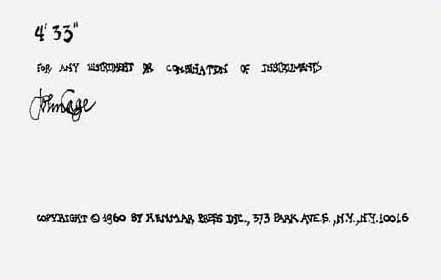
Here’s a piece that sounds different every time you hear it.
John Cage, 4’ 33” (1952); David Tudor, piano
lagniappe
***
*****
musical thoughts
I didn’t wish it [4′ 33″] to appear, even to me, as something easy to do or as a joke. I wanted to mean it utterly and be able to live with it.
***
Until I die there will be sounds. And they will continue following my death. One need not fear about the future of music.
Monday, n. the day the weekly tide of confusion rolls in.
How about something simple?
John Cage (1912-1992), Six Melodies (for violin and keyboard; dedicated to Josef & Anni Albers), 1950; Annelie Gahl (violin) & Klaus Lang (electric piano), 2010
You don’t need to be asleep to be lost in a dream.
Maurice Ravel, Piano Concerto in G Major (1929-31); Martha Argerich, piano; Orchestre National de France (Charles Dutoit, cond.); live, Germany (Frankfurt), 1990
Music, for some people, is no less vital than oxygen.
James Rhodes, talking and playing (2010)
**********
lagniappe
reading table
To Praise the Music
by William Bronk (1918-1999)
Evening. The trees in late winter bare
against the sky. Still light, the sky.
Trees dark against it. A few leaves
on the trees. Tension in their rigid branches as if
–oh, it is all as if, but as if, yes,
as if they sang songs, as if they praised.
Oh, I envy them. I know the songs.
As if I know some other things besides.
As if; but I don’t know, not more
than to say the trees know. The trees don’t know
and neither do I. What is it keeps me from praise?
I praise. If only to say their songs,
say yes to them, to praise the songs they sing.
Envied music. I sing to praise their song.
(Want to hear Bronk, a MCOTD Hall of Famer, read this? Here.)
*****
art beat: more from Tuesday’s stop at the Art Institute of Chicago
Sometimes what you’re looking for—when, say, your hard drive crashes (as mine just did)—is something where not much seems to happen, beautifully.
John Luther Adams, “The Farthest Place” (2001); piano (Clint Davis), vibraphone (Brian Archinal & Andy Bliss) bass (Satoru Tagawa), violin (Lydia Kabalen); University of Kentucky (Lexington), 2008
**********
lagniappe
There are all kinds of music.
Gerard Manley Hopkins, “The Leaden Echo and the Golden Echo”
Richard Burton


 music clip of the day