These folks—three reed players and a cellist from Chicago, along with a drummer from Norway—will be playing (and recording a live album) at a performing-arts center on the city’s northwest side (Elastic Arts).
Dave Rempis (saxophones), Keefe Jackson (reeds), Jason Stein (bass clarinet), Tomeka Reid (cello), Tollef Østvang (drums), live, Lafayette, Ind., 4/25/15
Charles Mingus, composer, bandleader, bassist
April 22, 1922-January 5, 1979
Better late than never for someone who, like Miles and Monk, Bach and Beethoven, I couldn’t live without.
Charles Mingus (bass) with Eric Dolphy (alto saxophone, bass clarinet, flute), Clifford Jordan (tenor saxophone), Johnny Coles (trumpet), Jaki Byard (piano), Dannie Richmond (drums), live, Belgium, Norway, and Sweden, 1964*
**********
lagniappe
musical thoughts
There’s something about listening to Eric Dolphy that makes you feel glad to be alive.
Belgium
00:00-00:45 Intro
00:46-05:33 So Long Eric
05:35-11:20 Peggy’s Blue Skylight
11:23-32:03 Meditations On Integration
Norway
32:30-54:46 So Long Eric
56:30-1:11:40 Orange Was The Color Of Her Dress, Then Blue Silk
1:13:53-1:16:20 Parkeriana
1:16:22-1:29:05 Take The “A” Train
Sweden
1:30:05-1:33:55 So Long Eric
1:34:02-1:52:35 Meditations On Integration
1:52:40- 1:59:50 So Long Eric
He played a version of this, wonderfully, along with Steve Reich’s “New York Counterpoint” and Duke Ellington’s “Come Sunday,” at the Chicago Cultural Center.
James Falzone, “Sighs Too Deep For Words,” live (studio performance), 2011
**********
lagniappe
random thoughts
Why settle for a mirror when you could have a window?
If your appetite for new music is insatiable, what better time to be alive?
Tyshawn Sorey (1980-), Quartet for Butch Morris (2012); International Contemporary Ensemble (ICE), featuring Erik Carlson (violin); Joshua Rubin (bass clarinet), Eric Lamb (flute), Cory Smythe (piano); live, New York, 2012
Six decades of listening and, until yesterday, I’d never heard this particular combination of instruments. You?
**********
lagniappe
art beat: yesterday at the Art Institute of Chicago
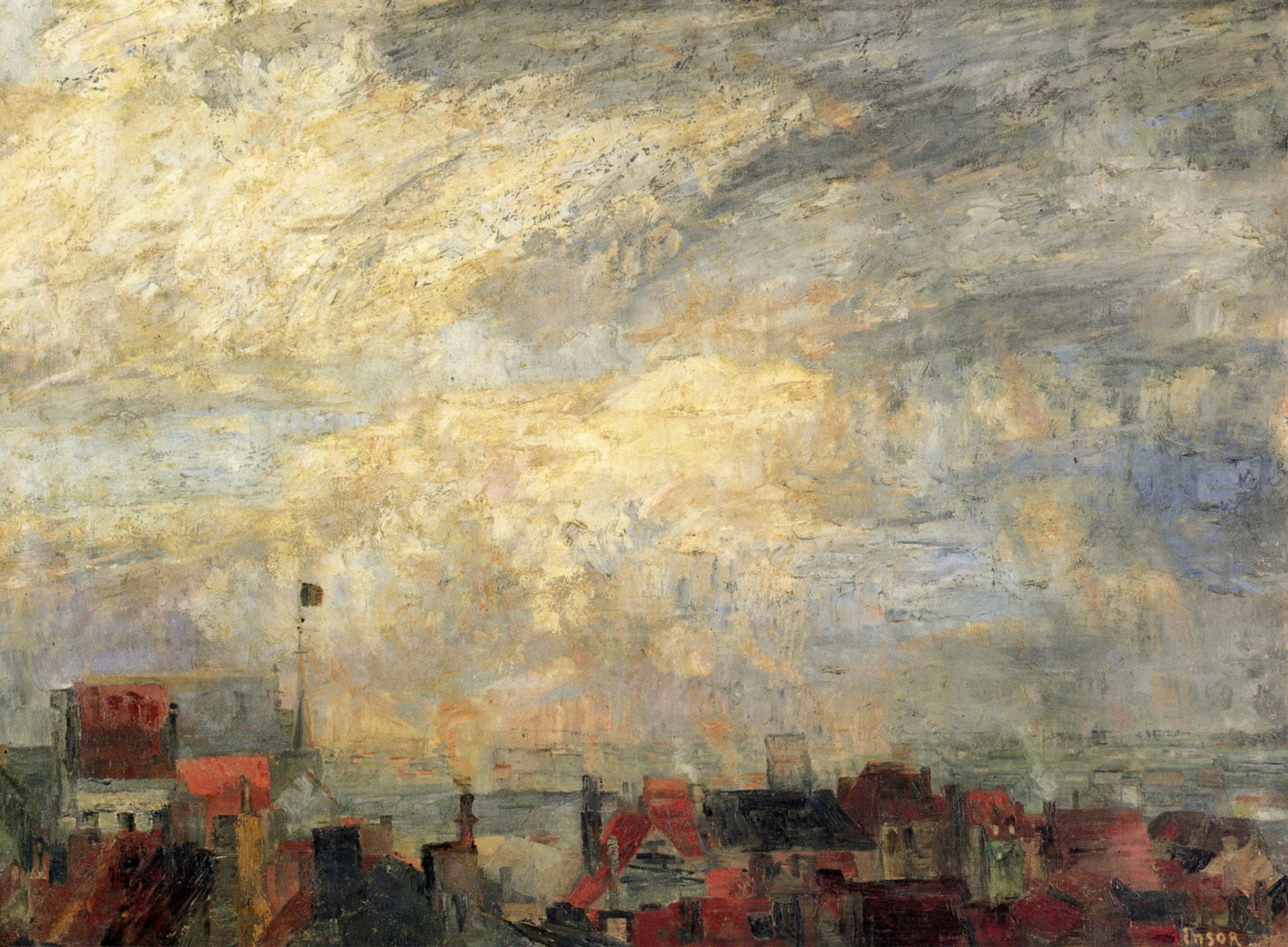
James Ensor (1860-1949), Rooftops of Ostend, 1884 (Temptation: The Demons of James Ensor, through January 25th)
*****
reading table
Nature, the sky above us, is conducting no mean politics when it presents beauty to all, without discrimination, and nothing old and defective, but fresh and most tasty.
—Robert Walser (1878-1956), “Snowdrops,” excerpt (translated from German by Tom Whalen and Trudi Anderegg)
What better way to start the year than with the music of Sly Stone?
Steven Bernstein’s Millennial Territory Orchestra (Steven Bernstein, trumpet; John Medeski, organ, et al.), live, Paris, 2011
“Stand” (feat. Sandra St. Victor, vocals)
***
“Everyday People” (feat. Eric Mingus, vocals)
*****
Still, after four decades, this album remains on my desert-island list.
Sly and the Family Stone, Fresh, 1973
1. In Time (0:00)
2. If You Want Me To Stay (5:48)
3. Let Me Have It All (8:48)
4. Frisky (11:43)
5. Thankful ‘N’ Thoughtful (14:54)
6. Skin I’m In (19:36)
7. I Don’t Know (Satisfaction) (22:29)
8. Keep On Dancin’ (26:23)
9. Que Sera, Sera (Whatever Will Be, Will Be) (28:45)
10. If It Were Left Up To Me (34:07)
11. Babies Makin’ Babies (36:07)
Charles Ives (1874-1954), Ragtime Dance No. 4 (1904)
Alarm Will Sound, live, New York, 2013
***
Orchestra New England, recording, 1990
**********
lagniappe
musical thoughts
As I remember some of the dances as a boy, and also from father’s description of some of the old dancing and fiddle playing, there was more variety of tempo than in the present-day dances. In some parts of the hall a group would be dancing in polka, while in another, a waltz. Some of the players in the band would, in an impromptu way, pick up with the polka, and some with the waltz, and some with a march. Often the piccolo or cornet would throw in asides. Sometimes a change in tempo, or a mixed rhythm would be caused by a fiddler who, after playing three or four hours steadily, was getting a little sleepy. Or maybe another player was seated too near the hard cider barrel. Whatever the reason for these changes and simultaneous playing of things, I remember distinctly catching a kind of music that was natural and interesting and which was decidedly missed when everybody came down ‘blimp’ on the same beat again.
 music clip of the day