joy, n. looking for something else and happening upon this.
Jack DeJohnette’s Special Edition (JD, drums; Rufus Reid, bass; Marty Erlich, bass clarinet; John Purcell, alto saxophone; Howard Johnson, tuba, baritone saxophone), live, Poland (Warsaw), 1983
Part 1
***
Part 2
***
Part 3
***
Part 4
**********
lagniappe
reading table
First, I’ll tell about the robbery our parents committed. Then about the murders, which happened later. The robbery is the more important part, since it served to set my and my sister’s lives on the courses they eventually followed. Nothing would make complete sense without that being told first.
Our parents were the least likely two people in the world to rob a bank. They weren’t strange people, not obviously criminals. No one would’ve thought they were destined to end up the way they did. They were just regular—although, of course, that kind of thinking became null and void the moment they did rob a bank.
exhilarating, adj. making you feel happy, excited, and full of energy. E.g., the music of Anthony Braxton.
Ken Vandermark, arrangments, bass clarinet; Nick Mazzarella, alto saxophone; Mars Williams, alto saxophone; Dave Rempis, baritone saxophone; Josh Berman, cornet; Jeb Bishop, trombone; Jason Adasiewicz, vibraphone; Nate McBride, bass; Tim Daisy, drums; live, Chicago (Elastic, 2830 N. Milwaukee), 6/21/12
Composition No. 6 C (A. Braxton)
***
Composition No. 69 J (A. Braxton)
**********
lagniappe
Anthony Braxton sat perched on a piano bench one recent afternoon, hands folded in his lap, wearing an intent but unreadable expression. Angled away from the piano in a no-frills rehearsal space in Brooklyn, he faced the dozen or so vocalists that currently make up his Syntactical Ghost Trance Music Choir. The singers, arranged in a semicircle, were tackling Mr. Braxton’s “Composition No. 256,” staring hard at their sheet music while trying to keep track of their conductor. It was starting to seem as if the piece, a slippery, scalar proposition, were getting the best of them.
“O.K.,” said Taylor Ho Bynum, the conductor, waving the singers to a halt. Mr. Bynum, a cornetist, composer, bandleader and former student of Mr. Braxton’s at Wesleyan University, took a moment to describe the cues and signals that would further convolute the interpretation of the piece. “When in doubt, we follow Braxton,” he said.
“Which is to say, you know it’s going to be wrong!” Mr. Braxton fired back, laughing.
Mr. Bynum nodded, deadpan. “We’d follow Braxton off a cliff.”
***
Mr. Braxton, 66, has been a force in the American avant-garde since the 1960s, when he emerged in his native Chicago as a member of the Association for the Advancement of Creative Musicians. Within the first decade of his arrival, he was being toasted in some circles as “the new messiah, the new Charlie Parker-John Coltrane-Ornette Coleman,” as Whitney Balliett put it in The New Yorker.
As a composer, conceptualist and saxophonist, Mr. Braxton exemplified the steep intellectualization of one wing of jazz’s avant-garde; his compositions often included notation in the form of pictographs and algebraic formulas, and he wrote pieces not only for jazz ensembles but also for classical orchestras (in one memorable instance, for four of them at once). One piece from 1971, “Composition 19 (For 100 Tubas),” finally had its premiere five years ago as a rumbling overture to that year’s Bang on a Can Marathon in Lower Manhattan.
“I wanted to have an experience like my role models,” Mr. Braxton said after the rehearsal, at a nearby pub. “Karlheinz Stockhausen, Charlie Mingus, Iannis Xenakis, Sun Ra, Hildegard von Bingen. The people who were thinking large scale and small scale. I might not have been able to get the money to do what I would have liked to do. But you can still compose it and have the hope that maybe in the future it can be realized.”
Mr. Braxton has often suggested that his sprawling output — and the equally irreducible theoretical discourse surrounding it — should be understood as a single body of work. To that end, his music has become a bit more accessible recently, thanks to a spate of archival releases. But that hasn’t made things easier for Mr. Braxton.
“This is a somewhat frustrating time cycle for me, in the sense that I rarely work anymore,” he said. “My work has been marginalized as far as the jazz-business complex is concerned, or the contemporary-music complex.” Were it not for his tenured post at Wesleyan, where he has taught for more than 20 years, “maybe I would be driving a taxicab or something,” he said.
***
“I had never thought that I would be involved in narrative structures,” Mr. Braxton said [of his new opera Trillium J]. “As a young guy, I was more interested in abstract modeling. But as I got older, I began to see that there was no reason to limit myself to any intellectual or conceptual postulate, when in fact I’m a professional student of music.”
Peter Brötzmann Chicago Tentet,* “Aziz” (M. Zerang), recorded live in Chicago (Empty Bottle), 9/17/97 (Okka Disk OD-12022)
**********
lagniappe
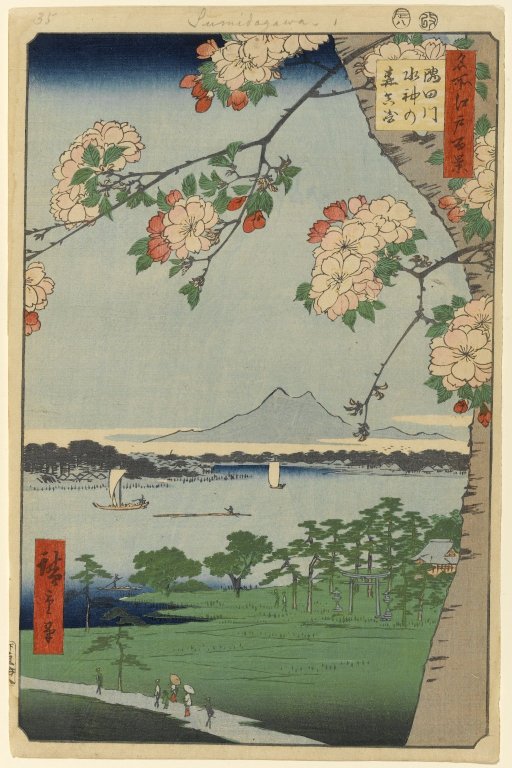
art beat: yesterday at the Art Institute of Chicago (after meeting with a client at the nearby federal jail)
Utagawe Hiroshige, Suijin Shrine and Massaki on the Sumida River (from the series One Hundred Famous Views of Edo), c. 1856
*****
reading table
Were I to choose an auspicious image for the new millennium, I would choose . . . the sudden agile leap of the poet-philosopher who raises himself above the weight of the world, showing that with all his gravity he has the secret of lightness, and that what many consider to be the vitality of the times—noisy, aggressive, revving and roaring—belongs to the realm of death, like a cemetery for rusty old cars.
—Italo Calvino, “Lightness,” in Six Memos for the New Millenium (1988, translated from Italian by Patrick Creagh)
*****
*PB, tenor sax/clarinet/tarogato; Mars Williams, tenor/alto/soprano sax/clarinet; Ken Vandermark, tenor sax/clarinet/bass clarinet; Mats Gustafsson, baritone sax/fluteophone; Joe McPhee, pocket cornet/valve trombone/soprano sax; Jeb Bishop, trombone; Fred Lonberg-Holm, cello; Kent Kessler, bass; Michael Zerang, drums/percussion; Hamid Drake, drums/percussion.
Charles Mingus Quintet,* “So Long Eric,” “Peggy’s Blue Skylight,” “Meditations On Integration” (all by Mingus), live (TV show), Belgium, 1964
Mingus’s music, it seems, has everything. Call it “simple” or “complex” and you’d be both right and wrong—it’s both. Compositional elegance is balanced, exquisitely, with improvisational unruliness. Rhythmic momentum is no less—and no more—important than melodic invention. Like Ellington and Monk, he will, I’m confident, still be listened to a hundred years from now.
(Excerpts from this program have been posted previously.)
**********
lagniappe
art beat: yesterday at the Art Institute of Chicago
Ludovico Carracci, The Vision of Saint Francis, c. 1602
Going to the Art Institute again, after being away for a while, I felt a bit like someone who doesn’t realize he’s starving until he finds himself at a feast.
*****
*CM, bass; Eric Dolphy, alto saxophone, flute, bass clarinet; Clifford Jordan, tenor saxophone; Jaki Byard, piano; Dannie Richmond, drums.
Music doesn’t care who you are, where you come from, what you know. It asks only that you pay attention.
Stefan Wolpe (1902-1972), Piece in Three Parts for Piano and Sixteen Instruments (1961), Peter Serkin (piano), Chamber Music Society of Lincoln Center (Oliver Knussen, cond.)
How many sonic experiences are as dizzying as the one offered this time each year by WKCR-FM (Columbia University)? First there’s 24 hours, straight, of Ornette. The next 24? Bix, Bix, Bix.
Frankie Trumbauer and His Orchestra (feat. Bix Beiderbecke, cornet), “There’ll Come A Time (Wait and See),” 1928
Has there ever been a finer hour of jazz—of music—on TV?
The Sound of Jazz(CBS), 1957*
(A couple excerpts have been posted previously—here and here—but until the other day I’d never seen the whole show.)
*With Count Basie (piano), Thelonious Monk (piano), Billie Holiday (vocals), Jimmy Rushing (vocals), Coleman Hawkins (tenor saxophone), Ben Webster (tenor saxophone), Lester Young (tenor saxophone), Gerry Mulligan (baritone saxophone), Jimmy Giuffre (tenor saxophone, clarinet), Pee Wee Ellis (clarinet), Henry “Red” Allen (trumpet), Roy Eldridge (trumpet), Vic Dickenson (trombone), Danny Barker (guitar), Freddie Green (guitar), Jim Hall (guitar), Milt Hinton (bass), Jo Jones (drums), et al.

 music clip of the day