music clip of the day

jazz/blues/rock/classical/gospel/more

Category: Chicago

Monday, 10/29/12

Miles

Miles Davis Group,* live, Germany (Berlin), 1971

**********

lagniappe

art beat: Friday at the Art Institute of Chicago (after a hearing at the nearby federal court building)

Allen Ruppersberg, No Time Left To Start Again/The B and D of R’n’R (through 1/6/13)**

*****

*With Gary Bartz, saxophones; Keith Jarrett, keyboards; Michael Henderson, bass; Leon Chancler, drums; Don Alias & James Mtume, percussion.

**“B and D”=birth and death.

Friday, 10/19/12

only rock ’n’ roll

The Ex & Brass Unbound,* live, Dublin, 2010

**********

lagniappe

last night

He read at the Art Institute of Chicago, where I sat rapt and happy.

Seamus Heaney, “Postscript,” Dublin, 2011

*****

*Mats Gustafsson (baritone saxophone), Ken Vandermark (tenor saxophone), Wolter Wierbos (trombone), Roy Paci (trumpet).

Sunday, 10/14/12

Bobby testifies.

The Womack Brothers (with Bobby, then 17, on lead vocal), “Couldn’t Hear Nobody Pray” (SAR Records [Sam Cooke’s label]; rec. 6/28/1961, Universal Recording Studios, Chicago)

*****

The next year, as the Valentinos, they recorded this.

The Valentinos (with Bobby on lead vocal), “Lookin’ For A Love” (SAR Records, 1962)

Saturday, 10/6/12

my favorite 103-year-old composer

Elliott Carter (December 11, 1908-), Esprit Rude/Esprit Doux (1985); Claire Chase (flute),* Joshua Rubin (clarinet), International Contemporary Ensemble; live, Brazil (Sao Paulo), 2012

**********

lagniappe

musical thoughts

The “opportunity cost” of listening to something you already know, to borrow from the dreary world of economics, is that you’re forgoing an opportunity to discover something new.

*****

 found words

Last night, after a concert at the University of Chicago’s Mandel Hall (Takacs Quartet), I stopped at Harold’s Chicken Shack on 53rd Street, as much for old times’ sake as anything else (Harold got me through law school), and found this at the bottom of the receipt:

REFUNDS WITHIN 24 HOURS

MUST BRING FOOD BACK

**********

*Winner of a 2012 MacArthur “genius grant.”

Wednesday, 9/5/12

Happy (100th) Birthday, John!

John Cage, composer, September 5, 1912-August 12, 1992

Today, celebrating his centennial, we revisit past clips.

*****

10/9/09

No matter where you are, this landscape is just around the corner.

John Cage (1912-1992), In a Landscape (1948); Stephen Drury, piano

**********

lagniappe

musical thoughts

Music is a means of rapid transportation.

***

What I’m proposing, to myself and other people, is what I often call the tourist attitude—that you act as though you’ve never been there before. So that you’re not supposed to know anything about it. If you really get down to brass tacks, we have never been anywhere before.

***

As far as consistency of thought goes, I prefer inconsistency.

—John Cage

*****

5/22/10

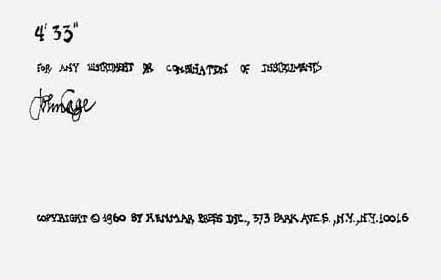
Here’s a piece that sounds different every time you hear it.

John Cage, 4’ 33” (1952); David Tudor, piano

lagniappe

***

*****

musical thoughts

I didn’t wish it [4′ 33″] to appear, even to me, as something easy to do or as a joke. I wanted to mean it utterly and be able to live with it.

***

Until I die there will be sounds. And they will continue following my death. One need not fear about the future of music.

—John Cage

*****

3/8/12

John Cage, Two (1987)

Live, Netherlands (Amsterdam), 2009
Dante Boon (piano), Rutger van Otterloo (soprano saxophone)

*****

Recording, 1991 (hat Art)
Marianne Schroeder (piano), Eberhard Blum (flute)

**********

lagniappe

musical thoughts

Every something is an echo of nothing.

—John Cage, Silence (1961)

*****

7/23/12

Monday, n. the day the weekly tide of confusion rolls in.

How about something simple?

John Cage (1912-1992), Six Melodies (for violin and keyboard; dedicated to Josef & Anni Albers), 1950; Annelie Gahl (violin) & Klaus Lang (electric piano), 2010

*****

lagniappe (new stuff)

radio

Today it’s all Cage all day at WKCR-FM.

***

art beat: more from Sunday’s stop at the Art Institute of Chicago

Agnes Martin, Untitled #12, 1977 (detail)

***

another birthday, closer to home

Today also marks the birthday of MCOTD—our third.

Thursday, 8/30/12

playing this weekend at the Chicago Jazz Festival

Matt Wilson’s Arts & Crafts* (Sunday, 3:30 p.m.)
“We See” (T. Monk), live, New York, 2011

(Paul Motian, this guy—drummers seem to have a particular feeling for Monk.)

*****

Steve Coleman and Five Elements** (Sunday, 7:10 p.m.)
Live, New York, 2010

*****

Ken Vandermark’s Made To Break Quartet*** (Sunday, 2:20 p.m.)
Live, Barcelona, 2011

*****

*MW, drums; Terell Stafford, trumpet; Gary Versace, piano; Martin Wind, bass.

**SC, alto saxophone; Jonathan Finlayson, trumpet; Tim Albright, trombone; Miles Okazaki, guitar; David Virelles, piano; Thomas Morgan, bass; Marcus Gilmore, drums.

***KV, reeds; Christof Kurzmann, electronics; Devin Hoff, bass; Tim Daisy, drums.

Friday, 8/24/12

timeless

Sly and the Family Stone

“Thank You (Falettinme Be Mice Elf Again),” TV Show (Soul Train), 1974

*****

“In Time,” Fresh, 1973

Jazz legend Miles Davis was so impressed by the song “In Time” . . . that he made his band listen to the track repeatedly for a full 30 minutes. Composer and music theorist Brian Eno cited Fresh as having heralded a shift in the history of recording, “where the rhythm instruments, particularly the bass drum and bass, suddenly [became] the important instruments in the mix.”

Wikipedia

**********

lagniappe

art beat: more from Tuesday’s stop at the Art Institute of Chicago

Roy Lichtenstein, Landscape in Fog (1996)

Thursday, 8/23/12

Music, for some people, is no less vital than oxygen.

James Rhodes, talking and playing (2010)

**********

lagniappe

reading table

To Praise the Music
by William Bronk (1918-1999)

Evening. The trees in late winter bare
against the sky. Still light, the sky.
Trees dark against it. A few leaves
on the trees. Tension in their rigid branches as if
–oh, it is all as if, but as if, yes,
as if they sang songs, as if they praised.
Oh, I envy them. I know the songs.

As if I know some other things besides.
As if; but I don’t know, not more
than to say the trees know. The trees don’t know
and neither do I. What is it keeps me from praise?
I praise. If only to say their songs,
say yes to them, to praise the songs they sing.
Envied music. I sing to praise their song.

(Want to hear Bronk, a MCOTD Hall of Famer, read this? Here.)

*****

art beat: more from Tuesday’s stop at the Art Institute of Chicago

Roy Lichtenstein, Mirror #3 (Six Panels) (1971)


Wednesday, 8/22/12

It’s impossible, sometimes, to separate our experience of music, especially pop music, from the surrounding circumstances. The other day, for instance, I was taking my son Luke back to school in Bloomington, Indiana. He was playing dashboard DJ. As we rolled through the hills of southern Indiana, nearing our destination, this came on after a long stretch of hip-hop (Lil Wayne, Eminem, Young Jeezy, Tyga, et al.), and the electronic intro, the Björk-like voice—they lit up the highway.

Ellie Goulding, “Lights”

**********

lagniappe

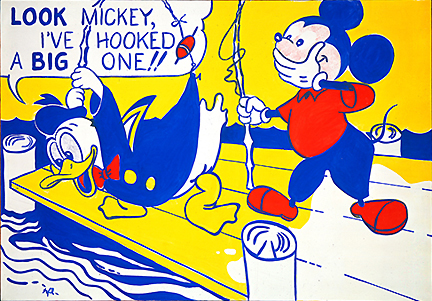
art beat: yesterday at the Art Institute of Chicago (after a hearing at the nearby federal court building)

Roy Lichtenstein: A Retrospective (through 9/3/12)

Look Mickey (1961)

*****

Artist’s Studio “Look Mickey” (1973)

Monday, 8/20/12

more Von Freeman

Live, New Apartment Lounge, 504 E. 75th St., Chicago
With Mike Allemana, guitar, Matt Ferguson, bass; Michael Raynor, drums

“Mr. P.C.” (J. Coltrane, excerpt), 11/30/04

***

“Blame It on My Youth” (O. Levant & E. Heyman), 6/8/10

**********

lagniappe

Von Freeman, who was considered one of the finest tenor saxophonists in jazz but attained wide fame only late in life, died on Aug. 11 in Chicago. He was 88.

The cause was heart failure, his son Mark said.

Though his work won him ardent admirers, Mr. Freeman, familiarly known as Vonski, was for decades largely unknown outside Chicago, where he was born and reared and spent most of his life.

As The Chicago Tribune wrote in 1998, his playing “represents a standard by which other tenor saxophonists must be judged.”

Last year, Mr. Freeman was named a National Endowment for the Arts Jazz Master, the nation’s highest honor in the field.

Not until the 1980s did he begin performing more often on famous out-of-town stages, including Alice Tully Hall and the Village Vanguard in New York. Earlier in his career Mr. Freeman had made much of his living, as he told The Tribune, playing for “strip joints, taxi dances, vaudeville shows, comedians, jugglers, weddings, bar mitzvahs, jazz clubs, dives, Polish dances, Jewish dances, every nationality.”

If he never got his big break as a young player, Mr. Freeman said, then that was because he never especially sought one.

“I’m not trying to brag or nothing, but I always knew I could play, 50, 60 years ago,” he told The Tribune in 2002. “I really don’t play any different than the way I played then. And I never let it worry me that I didn’t get anywhere famewise, or I didn’t make hit records.”

What he preferred to chasing fame, he said, was playing jazz as he felt it demanded to be played. The result, critics agreed, was music — often dazzling, occasionally bewildering — that sounded like no one else’s.

Mr. Freeman’s playing was characterized by emotional fire (he was so intense he once bit his mouthpiece clean off); a huge sound (this, he said, took root in strip clubs where the band played from behind a curtain); and singular musical ideas.

His work had a daring elasticity, with deliberately off-kilter phrasing that made it sound like speech. He cherished roughness and imperfection, although, as critics observed, he could play a ballad with the best of them.

Where some listeners faulted him for playing out of tune, others praised him for exploiting a chromatic range far greater than the paltry 12 notes the Western musical scale offers.

“Don’t tune up too much, baby,” Mr. Freeman once told a colleague. “You’ll lose your soul.”

His masterly tonal control let him summon unlovely sounds whenever he chose to, and he chose to often. His timbre has been called wheezing, honking, rasping and, in the words of Robert Palmer of The New York Times in 1982, a “billy goat tone” — a description that, as context makes clear, was not uncomplimentary.

Earl LaVon Freeman was born in Chicago on Oct. 3, 1923. (His given name was occasionally spelled Earle.)

His father was a city policeman — a highly unusual job for a black man then — whose beat included the Grand Terrace Ballroom, a storied nightclub. There, Von soaked up the music of Louis Armstrong, Fats Waller, Earl Hines and other titans of the age.

Young Von pined for a horn, and as luck would have it there was one in the house. The fact that it was attached to his father’s Victrola did not deter him, and one day when he was about 7, he pried it off, drilled holes in it and began to blow.

Deplorable sounds ensued, and his father overheard. “He picked me up, just kind of shook me, then hardly spoke to me for about a year,” Mr. Freeman later told Down Beat magazine. But if only as a deterrent, his father bought him a saxophone.

By 12, Von was playing professionally in Chicago nightclubs, reporting for work armed with a note from his mother. It read, “Don’t let him drink, don’t let him smoke, don’t let him consort with those women, and make him stay in that dressing room.”

He graduated from DuSable High School, a public school famous for its jazz program (other alumni include Nat King Cole and Dinah Washington), and entered the Navy, playing in its jazz band.

After his discharge, Mr. Freeman resumed his career, sitting in with some of the finest musicians to appear in Chicago, including Dizzy Gillespie, Charlie Parker and John Coltrane.

He was often invited to join them on the road, but he turned most offers down. He was disinclined to leave home: besides his wife and four children, he had his mother to look after. She had been widowed since Von was a young man, when his father was shot and killed in the line of duty.

In later years, Mr. Freeman played at jazz festivals throughout the United States and Europe. But despite his newfound fame, till nearly the end of his life held court each Tuesday night at the New Apartment Lounge, a small Chicago club where he had performed since the early 1980s. “Vonski’s Night School,” musicians called his sessions there, and young players came from around the world for the chance to sit in with him.

Mr. Freeman’s marriage to Ruby Hayes ended in divorce. Besides his son Mark, he is survived by another son, Chico, a prominent tenor saxophonist, and a brother, George, a jazz guitarist. Two daughters, Denise Jarrett and Brenda Jackson, died before him, as did another brother, Eldridge (known as Bruz), a drummer.

His recordings include “Doin’ It Right Now,” (1972), “Young and Foolish” (1977), “The Great Divide” (2004), “Vonski Speaks” (2009) and, with Chico, “Freeman & Freeman” (1981).

Though Mr. Freeman had not looked for it, renown, when it came, was a vindication.

“A lot of people who didn’t pay a lot of attention to me or to my music started coming around when I was heading to my 80th birthday,” he told The Tribune in 2002. “Now they were saying, ‘Well, Vonski, you’re all right after all.’ ”

Margalit Fox, New York Times, 8/19/12