Monday, October 5th
Once I enter this world, I never want to leave.
Morton Feldman (1926-1987), For Philip Guston (1984); Either/OR (Richard Carrick, piano/celesta; Margaret Lancaster, flutes; David Shively, percussion), live, Philadelphia, 2015
Once I enter this world, I never want to leave.
Morton Feldman (1926-1987), For Philip Guston (1984); Either/OR (Richard Carrick, piano/celesta; Margaret Lancaster, flutes; David Shively, percussion), live, Philadelphia, 2015
Morton Feldman (1927-1986), Rothko Chapel (1971), live (excerpts), Houston (Rothko Chapel), 2013; Kim Kashkashian (viola), Steven Schick (percussion), Sarah Rothenberg (celeste), Hallie Reed (soprano), Houston Chamber Choir (Robert Simpson, cond.)
#1
#2
Today Morton Feldman enters the MCOTD Hall of Fame, joining saxophonists Von Freeman and Henry Threadgill, trumpeter Lester Bowie, poets John Berryman and Wislawa Szymborska and William Bronk, photographer Helen Levitt, and gospel singer Dorothy Love Coates.
**********
lagniappe
random thoughts
No matter how often we turn away, the world keeps calling out to us.
Look.
Listen.
Morton Feldman (1926-1987), Rothko Chapel (1971); Seattle Modern Orchestra (with Julia Tai, conductor; Melia Watras, viola; Stephen Olsen, celesta; Brian Yarkovsky, percussion; Sarah Marroquin, soprano), live, Seattle, 2012
Today Morton Feldman enters the MCOTD Hall of Fame, joining saxophonists Von Freeman and Henry Threadgill, trumpeter Lester Bowie, poets William Bronk and Wislawa Szymborska, photographer Helen Levitt, and gospel singer Dorothy Love Coates.
**********
lagniappe
reading table
This performance reminds me at times of Emily Dickinson:
The Stillness in the Room
Was like the Stillness in the Air—
Between the Heaves of Storm——No. 591 (Johnson), “I heard a Fly buzz”
*****
art beat: yesterday at the Art Institute of Chicago
Jean-Luc Mylayne (1946-), No. 560, 2008 (Mutual Regard, through August 23rd)
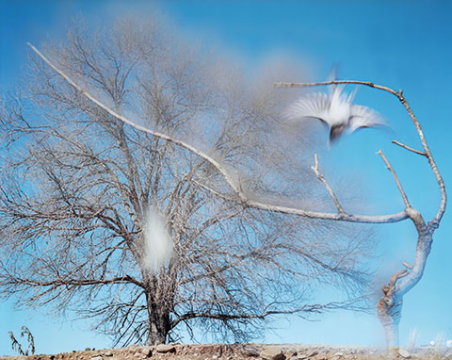
career plans for the next life
Maybe, instead of those other things (tap dancer, rubboard player in a zydeco band, bass player in a reggae band, guitar player in a Malian band, cellist in a string quartet), I’ll be a bird.
John Luther Adams (1953-), songbirdsongs (1974-80), Callithumpian Consort (Stephen Drury, dir.), recording (2012)
**********
art beat
Tony Fitzpatrick (1958-), Lunch Drawing #48: A Bird for Bruce Lee

Five hours?
As far as I’m concerned, this could go on forever.
Morton Feldman (1926-1987), For Philip Guston (1984); Claire Chase (flute, alto flute, piccolo), Steven Schick (percussion), Sarah Rothenberg (piano, celesta), live (3:50-), Houston (Rothko Chapel), 11/2/14
**********
lagniappe
random thoughts: New Year’s resolution #1
Quit thinking other people should be more like me—if anything, be thankful they aren’t.
If you wanted to conjure a world of mystery, what better instrument to lead the way than one that possesses neither the brightness of the violin nor the darkness of the cello?
Morton Feldman, Rothko Chapel (1971), live, Houston (Rothko Chapel), 2011; Kim Kashkashian (viola), Brian Del Signore (percussion), Sarah Rothenberg (celeste), Maureen Broy Papovich (soprano), Houston Chamber Choir (Robert Simpson, cond.)
#1
***
#2
***
#3
Another take? Here.
**********
lagniappe
Rothko Chapel
***
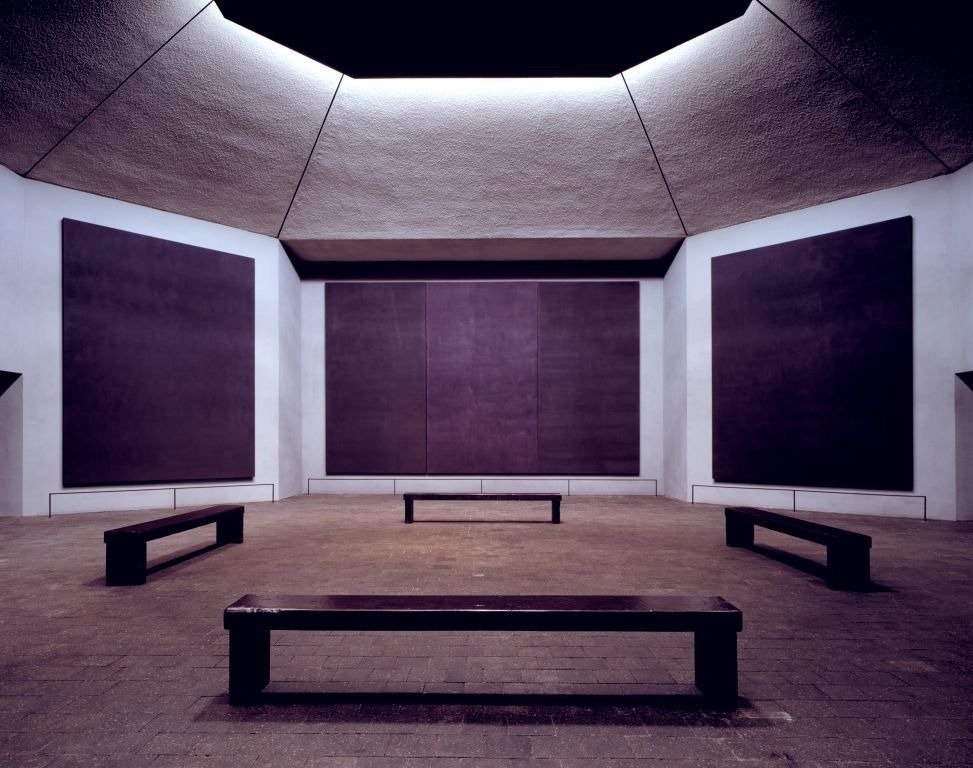
The Rothko Chapel is an interfaith sanctuary, a center for human rights — and a one-man art museum devoted to 14 monumental paintings by abstract expressionist Mark Rothko. The Houston landmark, commissioned by John and Dominique de Menil, opened its doors 40 years ago, in February 1971.
For the past four decades, the chapel has encouraged cooperation between people of all faiths — or of no faith at all. While the chapel itself has become an art landmark and a center for human-rights action, the sanctuary’s creator never lived to see it finished. Rothko committed suicide in 1970.
Approaching the chapel from the south, visitors first see a steel sculpture called Broken Obelisk by Barnett Newman in the middle of a pool — it appears to be floating on the surface of the water. The chapel itself is a windowless, octagonal brick building. Solid black doors open on a tiny glass-walled foyer. (The foyer was walled off from the rest of the interior when the Gulf Coast’s notorious humidity began to affect the paintings.)
The main room is a hushed octagonal space with gray stucco walls, each filled by massive paintings. Some walls feature one canvas, while on others, three canvases hang side by side to form a triptych. A baffled skylight subdues the bright Houston sun, and the surfaces of the paintings change dramatically as unseen clouds pass outside. There are eight austere wooden benches informally arranged, and today, a few meditation mats. A young woman brings the meditation hour to a close by striking a small bowl with a mallet, creating a soft peal of three bells in the intense silence of the room.
Concerts, conferences, lectures, weddings and memorial services all take place in the chapel throughout the year, but on most days you will find visitors — about 55,000 annually come to see, to meditate, to write in the large comment book in the foyer, to read the variety of well-thumbed religious texts available on benches at the entrance.
***
These paintings do not feature the luminous color fields that made Rothko famous. The paintings in the chapel are dark, in purplish or black hues. And there’s a reason for that, says [chapel historian Suna] Umari.
“They’re sort of a window to beyond,” she explains. “He said the bright colors sort of stop your vision at the canvas, where dark colors go beyond. And definitely you’re looking at the beyond. You’re looking at the infinite.”
***
At first glance, the paintings appear to be made up of solid, dark colors. But look closely, and it becomes evident that the paintings are composed of many uneven washes of pigment that create variations in every inch. Stepping back, waves of subtle color difference appear across the broad surfaces — leading to an unmistakable impression of physical depth.
***
Though Mark Rothko didn’t live to see the sanctuary he created, Christopher Rothko says his father knew what it should be.
“It took me a while to realize it, but that’s really my father’s gift, in a sense, to somebody who comes to the chapel. It’s a place that will really not just invite, but also demand a kind of journey.”
—Pat Dowell, “Meditation and Modern Art Meet In Rothko Chapel,” NPR, 3/1/11
*****
reading table
Our lives are Swiss –
So still – so Cool –
Till some odd afternoon
The Alps neglect their Curtains
And we look farther on!Italy stands the other side!
While like a guard between –
The solemn Alps –
The siren Alps
Forever intervene!—Emily Dickinson
Feel like floating?
Morton Feldman (1926-1987), For Philip Guston (1984)
S.E.M. Ensemble, 2000
Spirits need a lift?
Consider this: how much wonderful music—more than a lifetime’s worth—waits to be heard for the first time.
Morton Feldman, For Philip Guston (1984)*
Part 1
Part 2
Part 3
Part 4
More Feldman?
And here.
And here.
**********
lagniappe
musical thoughts
Q. This is a tough question, but what would be your five Desert Island disks?
John Luther Adams: I’d want music I could live inside for a long time; music that’s complex and enigmatic enough that there’s always something new to discover. Off the top of my head, my choices might be . . .
One of Morton Feldman’s major works, probably the Second String Quartet. Or maybe For Philip Guston.
**********
*For piano, celesta, piccolo, flute, alto flute, glockenspiel, vibraphone, marimba, chimes.
If you wanted to conjure a world full of mystery, what better instrument to lead the way than one that possesses neither the brightness of the violin nor the darkness of the cello?
Morton Feldman, Rothko Chapel (1971), live, Houston (Rothko Chapel), 2011; Kim Kashkashian (viola), Brian Del Signore (percussion), Sarah Rothenberg (celeste), Maureen Broy Papovich (soprano), Houston Chamber Choir (Robert Simpson, cond.)
Part 1
***
Part 2
***
Part 3
Another take? Here.
**********
lagniappe
Rothko Chapel, Houston, Texas
***
The Rothko Chapel is an interfaith sanctuary, a center for human rights — and a one-man art museum devoted to 14 monumental paintings by abstract expressionist Mark Rothko. The Houston landmark, commissioned by John and Dominique de Menil, opened its doors 40 years ago, in February 1971.
For the past four decades, the chapel has encouraged cooperation between people of all faiths — or of no faith at all. While the chapel itself has become an art landmark and a center for human-rights action, the sanctuary’s creator never lived to see it finished. Rothko committed suicide in 1970.
Approaching the chapel from the south, visitors first see a steel sculpture called Broken Obelisk by Barnett Newman in the middle of a pool — it appears to be floating on the surface of the water. The chapel itself is a windowless, octagonal brick building. Solid black doors open on a tiny glass-walled foyer. (The foyer was walled off from the rest of the interior when the Gulf Coast’s notorious humidity began to affect the paintings.)
The main room is a hushed octagonal space with gray stucco walls, each filled by massive paintings. Some walls feature one canvas, while on others, three canvases hang side by side to form a triptych. A baffled skylight subdues the bright Houston sun, and the surfaces of the paintings change dramatically as unseen clouds pass outside. There are eight austere wooden benches informally arranged, and today, a few meditation mats. A young woman brings the meditation hour to a close by striking a small bowl with a mallet, creating a soft peal of three bells in the intense silence of the room.
Concerts, conferences, lectures, weddings and memorial services all take place in the chapel throughout the year, but on most days you will find visitors — about 55,000 annually come to see, to meditate, to write in the large comment book in the foyer, to read the variety of well-thumbed religious texts available on benches at the entrance.
***
These paintings do not feature the luminous color fields that made Rothko famous. The paintings in the chapel are dark, in purplish or black hues. And there’s a reason for that, says [chapel historian Suna] Umari.
“They’re sort of a window to beyond,” she explains. “He said the bright colors sort of stop your vision at the canvas, where dark colors go beyond. And definitely you’re looking at the beyond. You’re looking at the infinite.”
***
At first glance, the paintings appear to be made up of solid, dark colors. But look closely, and it becomes evident that the paintings are composed of many uneven washes of pigment that create variations in every inch. Stepping back, waves of subtle color difference appear across the broad surfaces — leading to an unmistakable impression of physical depth.
***
Though Mark Rothko didn’t live to see the sanctuary he created, Christopher Rothko says his father knew what it should be.
“It took me a while to realize it, but that’s really my father’s gift, in a sense, to somebody who comes to the chapel. It’s a place that will really not just invite, but also demand a kind of journey.”
—Pat Dowell, “Meditation and Modern Art Meet In Rothko Chapel,” NPR, 3/1/11
*****
reading table
Our lives are Swiss –
So still – so Cool –
Till some odd afternoon
The Alps neglect their Curtains
And we look farther on!Italy stands the other side!
While like a guard between –
The solemn Alps –
The siren Alps
Forever intervene!—Emily Dickinson
Morton Feldman, For Christian Wolff (flute, piano, celesta; 1986)
Vodpod videos no longer available.Listening to this, you can find it hard to remember, after an hour or so, what the world sounded like before it began playing.
More? Here. And here. And here. And here. And here. And here.
**********
lagniappe
Imagine a long, narrow hallway with paintings—subtle, shimmering abstracts by Mark Rothko—hung along both walls. Imagine walking through the hallway, stopping to examine one painting closely before moving on to the next. Imagine the hallway extends for three miles without an exit. This should give you some idea of what listening to For Christian Wolff is like. What might be hell to some people could be an all-too-brief time spent in paradise for others.
—Art Lange, Fanfare, July/August 2009
*****
At the beginning of Morton Feldman’s “For Christian Wolff” at the Alternative Museum last Sunday afternoon, Nils Vigeland – who played the piano and celesta to Eberhard Blum’s flute – invited listeners with other engagements or expired patience to leave at will.
The few who did walk out before this three-and-a-half-hour musical experience was over neither insulted the spirit of the late Mr. Feldman’s piece nor necessarily missed anything. This music, with its trancelike exposition of simple intervals, can haunt one as much in one hour as it can in three.
“For Christian Wolff” is music whose internal clock has stopped. It offers us the moment, invites us to forget what has already happened and discourages any curiosity about the future. Mr. Wolff was on hand to honor his late colleague. His introductory words – which said little about either the music, the composer or himself – seemed terribly appropriate to the occasion.
***
“For Christian Wolff” . . . gives us a deflected image of silence. Like the shadows of Plato’s cave, it is a corporeal flicker of pure nothingness – the kind of music that in the heavens surely sets the toes of gods to tapping.
—Bernard Holland, New York Times, 4/1/90
 music clip of the day