The horn players—all eight of them—are sons of Sun RaArkestra trumpeter and AACM (Association for the Advancement of Creative Musicians) cofounder Phil Cohran.
The Black Men of Labor 2009 Second Line Parade, New Orleans
**********
lagniappe
The Black Men of Labor is an organization of African American men who promote and preserve traditional New Orleans cultural expressions through Parade Club traditions. Social Aid and Pleasure Clubs in New Orleans African American community were formed as early as the late 1700’s to respond to the lack of access to medical care, and insurance and to provide members proper burial. A direct link to West African traditions of burial and tribal societies is undeniable in the light of recent studies which tell us the history of West Africans in early Louisiana. The Black Men of Labor was founded in 1993 by Fred J. Johnson, Jr. and Musicians Benny Jones, Sr. and Gregory Stafford, to reaffirm and pay tribute to the contributions of African American men in the work place. The Black Men of Labor believes in the importance of the image which they uphold: honorable, hardworking, committed, law abiding citizens with a focus on preserving the history and culture of traditional Jazz Music which is passed on from generation to generation. Celebrated Jazz Musicians Mr. Danny and Mrs. Blu Lu Barker served as the inspiration for the Black Men of Labor to organize a meaningful Parade club which has returned traditional Jazz to the streets of New Orleans in the form of their annual Labor Day Parade. Members take pride in the fact their contributions have been the source of economic empowerment to a mixed minority group of local entrepreneurs and small business. The Black Men of Labor has consistently produced an annual Parade which attracts thousands of diverse people each year in a most peaceful and jovial atmosphere. The Parade also has another purpose. The Black Men of Labor seek to preserve traditional New Orleans Jazz by hiring musicians that play New Orleans Jazz music as it was performed by such great Brass Bands and musicians as Louis Armstrong, Danny Barker, Paul Barbarin, Duke Dejan, Milton Batiste, The Olympia Brass Band, the Onward, The Excelsior, Tuxedo, Eureka Brass Band, Doc. Paulin Brass Band, E. Gibson Brass Band, Reliance Brass Band, George Williams Brass Band, Cal Blunt
Brass Band, and the Royal Brass Band. It is the belief of The Black Men of Labor that more than any other single element of New Orleans culture, traditional New Orleans Jazz music is responsible for the City’s worldwide fame. The Black Men of Labor is committed to the preserving and continuing this music—on the streets, in the clubs, and gaining new audiences throughout the world. To further its commitment The Black Men of Labor have started a Mentoring Program to socially and economically disadvantage inner city young males from the age of 8-18 year of age in training, educating and grooming them in upholding this great culture and tradition through a weekend music program. The annual Parade always features a 15 member traditional Brass Band with multiple generation of musicians in full uniform (which consist of a Black Band Hat, White Shirt, Black Pants and Black Shoes) performing the best of New Orleans traditional Jazz with decorum and joy.
Today, in celebration of our second birthday, we revisit a few favorites from our first month.
*******
If I didn’t have kids, would my ears be stuck, forever, on “repeat”?
Here’s something my younger son Luke, who just started college, played for me recently, after first pronouncing it, with quiet but absolute authority, the best thing this guy has done (already Luke’s learned that what’s important isn’t to be right; it’s to seem right).
Lupe Fiasco, “Hip Hop Saved My Life,” live, Los Angeles, 2008
*****
And here’s a track my older son Alex played for me a couple weeks ago, before heading back to school.
Dirty Projectors, “Stillness Is The Move”
*****
Koan for aging parents: What is the sound of a childless house?
(Originally posted 9/14/09.)
*******
May, 2012
Nobel-Prize-winning economist devises a way to turn faces—images of them, that is—into marketable commodities: the more expressive the face, the greater the value.
March, 2013
Haiti is named one of the world’s wealthiest countries.
Arcade Fire, “Haiti” (Funeral, 2004)
(Originally posted 9/23/09.)
*******
Performances like this usually fall somewhere between disappointing and disastrous. So many things can—and usually do—go wrong when you take a bunch of folks who’re used to leading their own bands and throw them together onstage. People trip all over each another; flash trumps feeling. But this performance, with Albert King, Stevie Ray Vaughan, Paul Butterfield, and (at the end) B.B. King, has plenty of strong moments—some funny ones, too. Listen to Albert bark at Paul:“Turn around!” (0:39) And watch Albert outfox B.B. First he invites him back onstage (4:40) and then, just when B.B.’s about to take flight (5:55), he cuts him off—faster than you can say “wham”—with his own (wonderful) solo. So much for Emily Post.
Stevie Ray Vaughan, Albert King, Paul Butterfield, B.B. King, live, 1987
(Originally posted 9/18/09.)
*******
If spirit could be sold, New Orleans would be rich.
Rebirth Brass Band, live, New Orleans, 2009
**********
lagniappe
Brass band musicians are a wild bunch. They’re hard to control. The street funk that the Rebirth [Brass Band]plays definitely isn’t traditional—it might be in thirty years time.
—Lajoie “Butch” Gomez (in Mick Burns, Keeping the Beat on the Street: The New Orleans Brass Band Renaissance[2006])
(Originally posted 9/11/09.)
*******
Muddy Waters, Saul Bellow, Steppenwolf Theater Company (John Malkovich, John Mahoney, Gary Sinise, Laurie Metcalf, et al.), Curtis Mayfield: a lot of great artists, musical and otherwise, have come out of Chicago in the last 50 years. Among the greatest is this group: the Art Ensemble of Chicago. While the horn players (Roscoe Mitchell, Joseph Jarman, Lester Bowie) got the lion’s share of the attention, what gave their music its juice—what made it dance—was (as you’ll hear) one of the finest rhythm sections ever: Malachi Favors, bass; Don Moye, drums.
Art Ensemble of Chicago, live, Poland (Warsaw), 1982 (in four parts)
Part 1 of 4
Part 2 of 4
Part 3 of 4
Part 4 of 4
(I talk about the AEC in the past tense because, while recordings are still released under this name from time to time, with two key members [they were all “key members”] now dead—trumpeter Lester Bowie [1999] and bassist Malachi Favors [2004]—it just isn’t [nor could it be] the same.)
(Originally posted 9/8/09.)
*******
Here—with a shout-out to my brother Don, with whom (at the age of 15) I saw the MC5 in Chicago’s Lincoln Park during the 1968 Democratic Convention (when nobody outside the Detroit/Ann Arbor area [including us] knew who they were)—is an awfully good cover, from what might seem an unlikely source, of one of their “greatest hits.”
Jeff Buckley, “Kick Out The Jams,” live, Chicago, 1995
And here, courtesy, apparently, of the Department of Defense, is (silent) footage of the scene in Lincoln Park on August 25, 1968—the day the MC5 (who appear here fleetingly) played.
(Originally posted 9/7/09.)
*******
If influence were compensable, Claude Jeter of the Swan Silvertones—a huge influence on Sam Cooke, Curtis Mayfield, Eddie Kendricks (Temptations), Al Green, even Paul Simon (who took inspiration from a line in the Swans’ “hit” “Mary, Don’t You Weep” [“I’ll be a bridge over deep water if you trust in my name”] when he wrote “Bridge Over Troubled Water”)—would have, when he passed earlier this year at the age of 94, died a wealthy man.
When he leaves the house [in NYC], he whistles his favorite tune, ‘What A Friend We Have In Jesus,’ while greeting the assorted neighborhood junkies and prostitutes who knew him mainly as sometime manager of the [Hotel] Cecil. ‘What’s new, Jeter,’ they ask. ‘Nothing new, nothing good, just thank God for life up here with these heathens and muggers.’
—Anthony Heilbut, The Gospel Sound: Good New and Bad Times(1971)
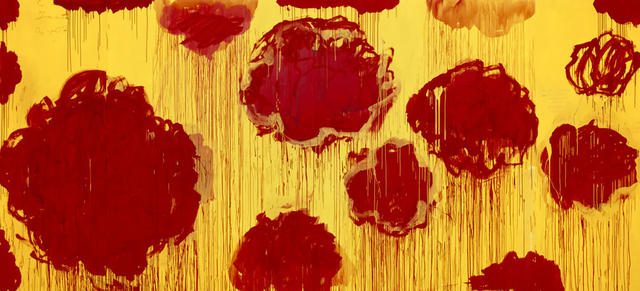
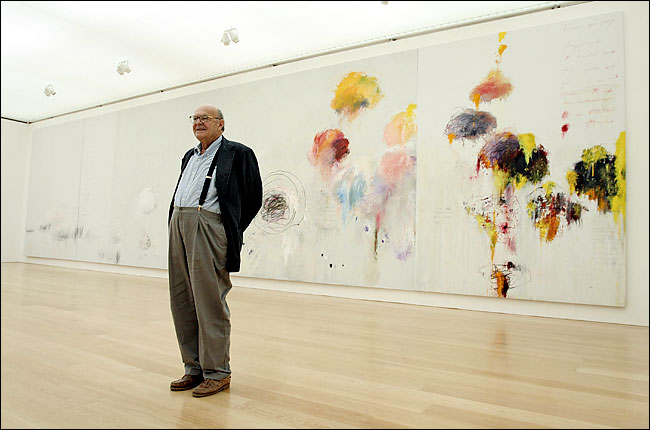
The death of Cy Twombly has an oddly catastrophic feel—oddly because he was eighty-three and a canonical master, but catastrophic because he takes with him a certain epochal, now thoroughly historical, sense of wide-open liberty in very high culture. Such was the cynosure of new art in New York sixty years ago, when Twombly had his first show of startlingly scrawly, somehow furiously languid paintings and drawings. Unlike the heroes of Abstract Expressionism and his comrades Rauschenberg and Johns, he never drove that afflatus. Rather, he took it as a routine state of mind and soul. This could seem dandyishly insolent of him: shrugging off the requirement for logical necessity in big-time avant-garde art. He made clear that he did what he felt like doing. His feeling-like-doing-it was the point, ever just a dramatic whisker short of pointlessness. Who did he think he was?


 music clip of the day
