music clip of the day

jazz/blues/rock/classical/gospel/more

Category: bass

Monday, 2/6/12

A lot of trumpet players try to bowl you over. This guy, whose last album appeared on many year-end top-10 lists (When the Heart Emerges Glistening, Blue Note), does something different. He gets under your skin.

Ambrose Akinmusire (ah-kin-MOO-sir-ee) Quintet (AA, trumpet; Walter Smith III, tenor saxophone; Fabian Almazan, piano; Harish Ragavan, bass; Justin Brown, drums); live, New York (Jazz Standard), 2011

Part 1

***

Part 2

***

Part 3

***

Part 4

**********

lagniappe

musical thoughts

Everything you don’t love, make sure that’s not in your playing.

—Steve Coleman (saxophonist, composer, bandleader) to Ambrose Akinmusire

*****

 passings

Wislawa Szymborska (vees-WAH-vah shim-BOR-ska), poet
July 2, 1923-February 1, 2012

The world—whatever we might think when terrified by its vastness and our own impotence, or embittered by its indifference to individual suffering, of people, animals, and perhaps even plants, for why are we so sure that plants feel no pain; whatever we might think of its expanses pierced by the rays of stars surrounded by planets we’ve just begun to discover, planets already dead? still dead? we just don’t know; whatever we might think of this measureless theater to which we’ve got reserved tickets, but tickets whose lifespan is laughably short, bounded as it is by two arbitrary dates; whatever else we might think of this world—it is astonishing.

But “astonishing” is an epithet concealing a logical trap. We’re astonished, after all, by things that deviate from some well-known and universally acknowledged norm, from an obviousness we’ve grown accustomed to. Now the point is, there is no such obvious world. Our astonishment exists per se and isn’t based on comparison with something else.

Granted, in daily speech, where we don’t stop to consider every word, we all use phrases like “the ordinary world,” “ordinary life,” “the ordinary course of events” . . . But in the language of poetry, where every word is weighed, nothing is usual or normal. Not a single stone and not a single cloud above it. Not a single day and not a single night after it. And above all, not a single existence, not anyone’s existence in this world.

—Wislawa Szymborska, Nobel Lecture (excerpt, translated from Polish by Stanislaw Baranczak and Clare Cavanagh), 12/7/96

More Szymborska? Here. And here. And here. And here.

Until 1996, when she was awarded the Nobel Prize in Literature, I’d never heard of her. Since then I’ve read virtually everything of hers that’s appeared in translation. How much does she mean to me? Well, she’s one of two charter members (the other’s saxophonist Von Freeman) of the ultra-exclusive MCOTD Hall of Fame.

Sunday, 2/5/12

one of my desert-island singers

Dorothy Love Coates (1928-2002) & the Gospel Harmonettes
“I Won’t Let Go” (AKA “I’m Just Holding On”), live

More?

Here. 

And here.

**********

lagniappe

Here’s the original recording (Specialty, 1950s).

*****

Were gospel to be more publicly acclaimed, she [Dorothy Love Coates] might have the stature of a Billie Holiday or a Judy Garland. Instead, for thousands of black people, she is the message carrier.

—Anthony Heilbut, The Gospel Sound: Good News and Bad Times (6th ed. 2002)

***

[I]t was obvious that Keith [Richards] and Gram [Parsons] enjoyed spending time together. . . . [W]e just all cared deeply about the same things. We just loved, for instance, to sit and listen to Dorothy Love Coates, the gospel singer.

—Stanley Booth

(Quotes originally posted 3/28/10.)

Friday, 2/3/12

When the groove’s this strong, I don’t ever want it to end.

Give me another take.

And another.

Another.

Black Dub (Brian Blade, drums; Trixie Whitley, drums, vocals; Daniel Lanois, guitar, vocals; Jim Wilson, bass, vocals), “Last Time”

1: Santa Monica, 2/16/11

***

2: Philadelphia, 11/18/10

***

3: Vancouver, 2/2/11

***

4: Hamburg, 7/21/11

Thursday, 2/2/12

most useless label?

 world music

 indie rock

 free jazz

The competition’s fierce.

Mostly Other People Do the Killing (Moppa Elliott, bass; Peter Evans, trumpet; Jon Irabagon, alto saxophone; Kevin Shea, drums), live, London (The Vortex), 7/14/11

**********

lagniappe

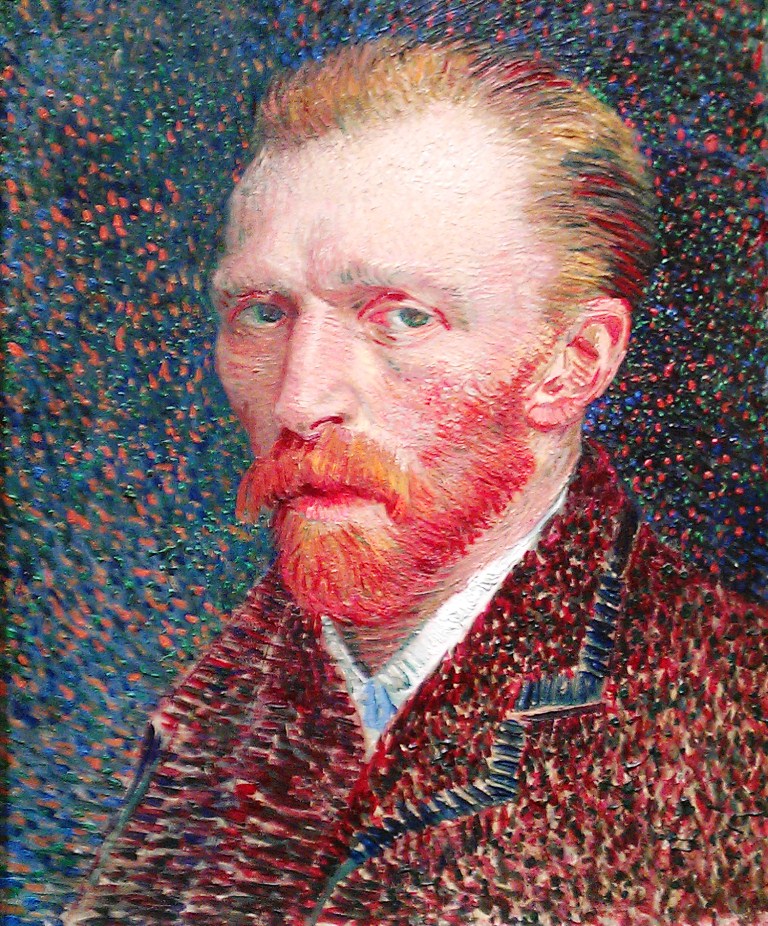
art beat: yesterday at the Art Institute of Chicago (after a hearing at the nearby federal court building)

Vincent van Gogh

The Bedroom (1889)

*******

Self-Portrait (1887)

With van Gogh, the life continually threatens to overtake the art; the challenge is to look with fresh eyes.

Monday, 1/30/12

Henry “Red” Allen (trumpet), with Coleman Hawkins (tenor saxophone), Vic Dickenson (trombone), Pee Wee Russell (clarinet), Rex Stewart (cornet), Danny Barker (guitar), Nat Pierce (piano), Milt Hinton (bass), Papa Jo Jones (drums), “Wild Man Blues,” live (TV Broadcast, The Sound of Jazz), 1957

All-star jam sessions often fizzle. Not this one. What makes this so good? A lot of it, I think, has to do with saxophonist Coleman Hawkins, who takes the first solo after trumpeter Red Allen states the melody. Right from the beginning (1:27-) it’s apparent that Hawkins isn’t just going through the motions. He plays, throughout, with great concentration and conviction, not wasting a moment. This inspires everyone; you can see it in their faces (1:44-47, 1:55-58, 2:03-08, 2:39-44). He gives the others a lot to live up to—and they do.

(Yo, Randy—thanks for the tip!)

Friday, 1/27/12

The 1960s—a decade of relentless experimentation, bold innovation, of searching, always, for something new, something true.

Freddie and the Dreamers, “Little Bitty Pretty One,” “A Little You”
Live, London, 1965

**********

lagniappe

reading table

Last night I had a dream. I was in France. Paris was again falling to the Germans, but it had become such a habit that one had to look closely to see that anyone really cared. I arrived in Paris (from the front, I think, but there wasn’t much of one) went to a party, where I was surrounded by acquaintances. They became distant and shadowy when I approached them. Suddenly I saw you and gave you a tremendous hug. You moved to another table. I said: ‘I know where there are a couple of good French restaurants.’ You said: ‘They’re all French here.’

—Robert Lowell, Letter to Elizabeth Bishop, 6/14/1953,
in The Letters of Robert Lowell (Saskia Hamilton ed., 2005)

Wednesday, 1/25/12

trying to teach white folks

This Is Ska! (1964)

**********

lagniappe

 found words

Real Messages from Heaven

—book title (Books-A-Million, 144 S. Clark St., Chicago)

Tuesday, 1/24/12

If you’re looking for sunshine, you’ll have to go elsewhere.

This is one of the saddest, darkest, most chilling things I know.

Nina Simone, “Black Is The Color Of My True Love’s Hair”

**********

lagniappe

reading table

[L]ife needs a lot of imaginative fixing, since it regularly fails to provide us with wild adventure and comfortable closure. ‘In life,’ Proust wrote in a notebook, ‘novels don’t finish.'”

—Michael Wood, “At the Movies,” London Review of Books, 1/5/12

Monday, 1/23/12

Yesterday we left off in 1977; let’s fast-forward 33 years.

Von Freeman (tenor saxophone), with Mike Allemana (guitar), Matt Ferguson (bass), Michael Raynor (drums); “Lester Leaps In,” live, Chicago (New Apartment Lounge, 75th St.), 2010 

**********

lagniappe

This year, as I’ve mentioned before, Von was awarded, along with bassist Charlie Haden, singer Sheila Jordan, trumpeter Jimmy Owens, and drummer Jack DeJohnette, an NEA (National Endowment of the Arts) Jazz Masters Fellowship—“the highest honor that our nation bestows on jazz artists.” Here’s the NEA’s video tribute.

Friday, 1/20/12

passings

Johnny Otis, December 28, 1921-January 17, 2012, singer, songwriter, piano player, bandleader, disc jockey, TV host, etc.

“Willie and the Hand Jive” (The Johnny Otis Show), c. late 1950s

**********

lagniappe

Genetically, I’m pure Greek. Psychologically, environmentally, culturally, by choice, I’m a member of the black community.

***

Society wants to categorize everything, but to me it’s all African-American music. The music isn’t just the notes, it’s the culture—the way Grandma cooked, the way Grandpa told stories, the way the kids walked and talked.

—Johnny Otis