music clip of the day

jazz/blues/rock/classical/gospel/more

Category: Africa

Wednesday, 9/21/11

Think you can listen to these guys without moving?

Just try.

Staff Benda Bilili
Live, Democratic Republic of Congo (Kinshasa)

“Na Lingui Yo,” c. 2007

Vodpod videos no longer available.

***

“Polio,” c. 2007

Vodpod videos no longer available.

***

Singing, playing, talking, 2011

Vodpod videos no longer available.

Friday, 8/19/11

sounds of Nigeria

Fela Kuti, live (filmed by Ginger Baker), Nigeria (Calabar), 1971

Vodpod videos no longer available.

More? Here.

**********

lagniappe

art beat: yesterday at Chicago’s Art Institute

Oda Kazuma, Catching Whitebait at Nakaumi, Izumo (1924)

*****

Mark Rothko, Untitled, 1953-54

*****

reading table

. . . life, that storm before the calm.

—Wislawa Szymborska, from “Negative” (trans. Clare Cavanagh & Stanislaw Baranczak, Monologue of a Dog [2006])

Friday, 7/8/11

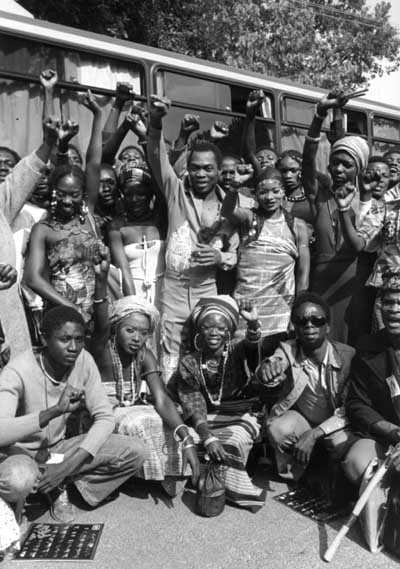
It takes a village, in Fela’s world, to put on a show.

Fela Anikulapo Kuti, October 15, 1938-August 2, 1997

Live, Paris, 1981

Part 1

Vodpod videos no longer available.

***

Part 2

Vodpod videos no longer available.

**********

lagniappe

1938 Born 15 October in Abeokuta, Nigeria to politically active and middle class family.

1958 Sent to London to train as a doctor, but instead enrolled in the Trinity College of Music. Formed Koola Lobitos in 1961.

1969 Took Koola Lobitos to Los Angeles. His political zeal was fired when he befriended radical black activists including Angela Davis.

1971 Kuti renames his band Afrika 70 (and later Eygpt 80), and, newly politicised, he determines to give voice to Nigeria’s underclass.

1974 After he enraged the Nigerian establishment, the army almost destroyed Kuti’s home while trying to arrest him.

1977 In a second government-sanctioned attack, 1,000 soldiers descended on Kuti’s compound. He suffered a fractured skull, arm and leg in the onslaught and his 82-year old mother was thrown from an upstairs window. He left for voluntary exile in Ghana.

1978 Ghanian authorities deported Kuti back to Lagos. On his arrival he married 27 women simultaneously. Divorcing them in 1986, he said: ‘ no man has the right to own a woman’s vagina’.

1979 Founded his own political party MOP (Movement of the People)

1984 Jailed in Nigeria for five years on what was regarded as sham currency smuggling charges, and released in 1986 after a change of government.

1996 Arrested and released on an alleged drug charge.

1997 Died of complications from Aids aged 59.

Peter Culshaw, The Guardian, 8/15/04

*****

Monday, 6/27/11

Someday, just as I sometimes do with my own father, who’s been gone for over thirty years, my older son Alex, now twenty-three, will recall occasions, after I’m gone, when he and I went out to hear live music together, like, for instance, last night, when we saw this group, from Africa, who are on their first U.S. tour.

Group Doueh, live, England (Bristol), 5/10/11

Vodpod videos no longer available.

More? Here. And here.

Wednesday, 6/1/11

One sign of a great performance—no matter what the genre—is that you find yourself on the edge of your seat, leaning forward, trying to get closer.

Orutu player and singer, percussionist, live, Kenya (Homa Bey), 1996

Vodpod videos no longer available.

Tuesday, 5/31/11

favorites
(an occasional series)

She’s going to be a big star someday.

Nneka, live

Vodpod videos no longer available.

(Originally posted 2/15/11.)

**********

It used to be that music came from a particular place. No more. Whether it’s Sohrab Saadat Ladjevardi (the Iranian saxophonist who’s lived in Germany, in Japan, and now in New York City [2/18/10]), or Burkina Electric (whose members come from Burkina Faso, from Germany, and from New York City [by way of Austria] [2/22/10]), or this singer, who’s lived (and has homes) in Nigeria and in Germany, much of today’s most intriguing music has its ears and heart and feet on more than one continent.

Nneka, “Heartbeat”

Take 1: recording/video

*****

Take 2: live, Philadelphia, 2009

*****

Take 3: J. Period Remix, featuring Talib Kweli

(Originally posted 2/27/10.)

Wednesday, 4/27/11

more sounds from the desert

Tinariwen, “Cler Achel,” live, London, 2007

Vodpod videos no longer available.

**********

lagniappe

The desert is where I feel the most comfortable, the most at ease, the most relaxed. It’s also where I’m inspired to create music. To be honest, I don’t like spending too long away from the desert now. Well, that’s to say, I still like touring and travelling and seeing different parts of the globe, but I also like to be at home. And in the desert there are a lot of people who can help us . . . by hiring us a house, by cooking, by playing music with us. We can’t take all those people with us if we go and record in Bamako or Paris.

***

Assouf means nostalgia, homesickness. We’ve all felt it a lot, ever since the time of exile began after the first [Tuareg] rebellion in 1963. It’s the feeling that is most important in our music. But it also means other things. It’s like a pain that you can’t see and can’t touch, a pain that lives in your heart. It means loneliness and separation too. When I was living in Algeria and Libya in the 1980s and 1990s I felt assouf a lot, and that’s when I wrote a lot of the songs I play today.

***

In the desert, everybody is always moving. That’s our culture. It’s very very hard sometimes to get together, or to stay in the same place. We need our freedom. So Tinariwen has survived because really almost every Tamashek musician in the northeast of Mali or the south of Algeria is part of Tinariwen. And if just two of them come together to sing our songs, that’s enough for it to be Tinariwen. In the past, that’s how our concerts happened. Hassan and Abdallah might perform in Bamako or Abidjan while I was hundreds of miles away in Tamanrasset or someplace. So I know that some people have been frustrated for example when I haven’t been present on stage in America. But that’s how Tinariwen has always been, loose and flexible. Otherwise we could never survive.

Ibrahim Ag Alhabib (songwriter, singer, guitarist)

Tuesday, 4/19/11

can’t wait
(an occasional series)

Bombino (AKA Omar Moctar, Goumar Almoctar, Bambino)
Chicago (Millennium Park), 7/11/11

More desert guitar.

Live, Niger

#1

Vodpod videos no longer available.

***

#2

Vodpod videos no longer available.

More? Here.

Monday, 4/18/11

can’t wait
(an occasional series)

Group Doueh, Chicago (Old Town School of Folk Music), 6/26/11

Live, Europe, 2009

Vodpod videos no longer available.

***

Doueh (guitar), Tony Allen (drums)
Live, rehearsal, Western Sahara (Dakhla), 2010

Vodpod videos no longer available.

More Group Doueh? Here. More Tony Allen? Here.

**********

lagniappe

I live in Dakhla [in Western Sahara]. There are other groups in the area, but Group Doueh is the main group for this area. We are the most in demand group for weddings and parties.

***

The power of Jimi Hendrix’s guitar is something that is inspirational on so many levels.

***

The main group is myself on guitar and tinidit. My wife Halima and friend Bashiri are the vocalists. My son Jamal is the keyboardist. There are also many percussionists that play with us from time to time. Also other singers will perform with us depending on who is available for certain weddings or parties.

***

For many years, most of our material was recorded on cassette. I have had many cassette recorders, some two-track, four-track and eight-track models. Now I am able to record digitally to a 16-track model. I am always experimenting to get the best situation. We always record at home and we record all of our performances.

***

[T]here really is no [music] industry [in Western Sahara]. I am an industry unto myself. I record music and have two shops that sell music to the community. Most of the recordings are done at home in makeshift studios, and cassettes or CDs are sold throughout the region.

Doueh (AKA Baamar Salmou)

*****

art beat: yesterday at the Art Institute of Chicago

Paul Cezanne, The Bay of Marselleilles, Seen From L’Estaque, c. 1885

The greatest jazz musicians—Miles Davis, Ornette Coleman, Von Freeman, et al.—can be identified by just one note. Cezanne’s that way, too. His blues are all his own.

Tuesday, 3/29/11

Zimbabwe

The music is as sweet as the news is bleak.

Zimbabwe College of Music Mbira Ensemble (with Thanda Richardson, vocals), live, Harare (Mannenberg Jazz Club), 2/17/08

Vodpod videos no longer available.

*****

Mbira Dzenharira, “Saramugomo,” 2001

Vodpod videos no longer available.

*****

SMG Young Stars, Kenge Art, Mutubambile Orphan Choir with Oliver Mtukudzi, Magariro Edu Marimba Band

Vodpod videos no longer available.

**********

lagniappe

reading table

. . . [Robert Mugabe’s] regime . . . has lost all its moral bearings, a gang of thieves and murderers bent on holding power at any cost. The book draws to a close with the testimony of Emmanuel Chiroto, a Harare opposition leader whose campaign for mayor has brought down the wrath of Mugabe’s goons. Even as he is celebrating his victory, members of the youth militia set his house on fire and abduct his wife, Abigail, and 4-year-old son. The boy is released, but Abigail’s swollen and battered corpse is found in the morgue. “This is my lovely wife,” Chiroto tells Godwin, holding up a cellphone image of Abigail in her wedding dress. “And they killed her.” Three years after his defeat at the polls, Mugabe still clings to power in his ruined nation. But Godwin’s intrepid reportage has at least given voice to some of his victims.

—Joshua Hammer, New York Times Book Review, 3/27/11 (review of The Fear: Robert Mugabe and the Martyrdom of Zimbabwe by Peter Godwin)

*****

sight seen

In Cambridge, Massachusetts, sitting on a brick sidewalk in Harvard Square, a panhandler with a large sign:

Seeking Human Kindness