One of the things I love about these guys is their name: you could hardly get
any simpler, any homelier.
Harmonizing Four
TV broadcast (TV Gospel Time), early 1960s
“That’s Alright”
***
“I’m Going Through”
*****
Recordings, 1957
“Farther Along”
***
“Motherless Child”
**********
lagniappe
It was 25 years ago . . . that four boys in the Dunbar Elementary School Glee Club in South Richmond [Virginia] decided to see what they could do with some close four part harmony. The director of the glee club encouraged their first efforts and pretty soon the Harmonizing Four developed to the point that the were invited to sing for civic meetings, clubs, schools, and churches all over the city.
—Program, 25th Anniversary Tribute to the Harmonizing Four, Richmond, Virgina, 1952 (quoted in Jerry Zolten, Great God A’Mighty! The Dixie Hummingbirds: Celebrating the Rise of Soul Gospel Music [Oxford 2003])
*****
odds & ends
• Elvis Presley was a huge fan of these guys, particularly bass singer Jimmy Jones. (Jones left the group in 1958, after these records were made but before this TV appearance, to form his own group [Jimmy Jones and The Sensationals]; he was replaced by Ellis Johnson.)
• One of the group’s members, Lonnie Smith (rear right on “That’s Alright”), is the father of keyboardist Lonnie Liston Smith.
Janis Joplin, “Get It While You Can” (J. Ragovoy)
Live, TV broadcast (The Dick Cavett Show), 1970
If she had lived, what would she sound like, at 68, today?
**********
lagniappe
reading table
We shall not ever meet them bearded in heaven,
Nor sunning themselves among the bald of hell;
If anywhere, in the deserted schoolyard at twilight,
Forming a ring, perhaps, or joining hands
In games whose very names we have forgotten.
Come, memory, let us seek them there in the shadows.
—Donald Justice, “On the Death of Friends in Childhood”
Howard Tate, singer, August 13, 1939-December 2, 2011
“Get It While You Can” (J. Ragovoy)
Live (with Jerry Ragovoy, piano), Paris, 2003
Like a lot of performances, this gets better as it goes along. At first he seems a bit tentative. He’s trying to find his way. Then, at around 1:07, he starts to settle in and, before long, he’s inhabiting the song. If this were a recording session and I had a hand in it, I know what I’d do as this was ending. I’d ask them, without missing a beat, to keep going: “Again, from the top.”
*****
Recording, 1967
**********
lagniappe
Howard Tate, 72, an immensely talented soul singer who dropped out of the music business in frustration after the often brilliant albums he made in the late 1960s and early 1970s failed to reach a wide audience, died Friday of multiple myeloma and leukemia in his apartment in Burlington City.
Born in Georgia and raised in Philadelphia, Mr. Tate returned to recording and performing in the 2000s after a chance encounter in a South Jersey supermarket led to his rediscovery.
Working with Philadelphia producer and songwriter Jerry Ragovoy, Mr. Tate recorded one undeniably classic album: Get It While You Can, a 1966 release on Verve whose title track became much better known when sung by Janis Joplin.
***
Neither his debut nor the subsequent Reaction (1969) and Howard Tate (1972) earned him a large audience. Mr. Tate, who had sung early in his career with organist Bill Doggett and with his fellow North Philadelphia soul man Garnet Mimms (in the doo-wop group The Gainors), wound up disappearing from the music business altogether – an absence that made his legend grow stronger.
Without music in his life, Mr. Tate, who was raised in the neighborhood around 13th and Norris Streets, sold insurance and raised six children. He started drinking after his daughter was killed in a fire in his Wynnefield home in 1976, he told The Inquirer in 2004. After his marriage crumbled, his life took a harrowing turn.
“I turned to cocaine, and it was the worst thing I could have ever done,” he said. “It destroyed my willpower. I became homeless, roaming around those drug neighborhoods in Camden. I actually thought I was going to be found dead in an alley. It was like I was waiting to die.”
Instead, however, the Baptist preacher’s son turned to the Lord. In 1994, he founded the Gift of the Cross Church and began preaching in living rooms in West Philadelphia and South Jersey.
Presumed dead by many, he ran into a former member of Harold Melvin & the Blue Notes in a Willingboro supermarket on New Year’s Day in 2001, who told him that an oldies DJ, Phil Casem of WNJC in Sewell, N.J., had been making inquiries about his whereabouts on the radio.
Two years later, Mr. Tate returned with Rediscovered, an album that included “Either Side of the Same Town,” a song Elvis Costello and Ragovoy, who died earlier this year, wrote for Mr. Tate. With his remarkable voice miraculously preserved after nearly three decades out of action, he returned to performing, and released two more albums, A Portrait of Howard (2006) and Blue Day (2008).
Mimms, now pastor of the Bottom Line Revival Church in Cheltenham, recalled Tuesday the days when he sang lead and Mr. Tate sang tenor in the Gainors, the quintet that came together after Mimms got out of the U.S. Army in 1958.
“We were very close,” said Mimms, who introduced Mr. Tate to Ragovoy and had his own Ragovoy-penned classic soul hit, “Cry Baby,” in 1963.
Mr. Tate “was a very nice dresser, and very famous with the young ladies,” Mimms said. “He was an all outgoing guy, and his falsetto was unique. I had a high range myself, but I couldn’t do that falsetto stuff he did. He could come out of his natural, and go right into it. He had a great voice.”
What a treat to hear a guitar-led group that sounds so fresh.
Nels Cline (guitar) and Friends play the music of Andrew Hill
Live, New York (Jazz Standard), 2007
**********
lagniappe
musical thoughts
The more one studies the harmony of music, and then studies human nature, how people agree and how they disagree, how there is attraction and repulsion, the more one will see that it is all music.
In a country that paid proper respect to its cultural heritage, this would be played for children in school, as part of their cultural education. Instead kids encounter it, if at all, on TV—the soundtrack to a Viagra commercial.
***
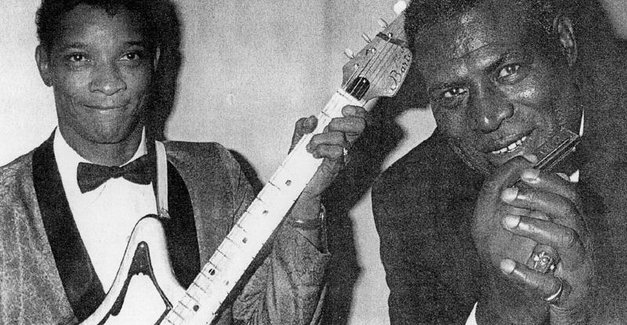
“Back Door Man” (rec. 1960, Chicago)
***
“Wang Dang Doodle” (rec. 1960, Chicago)
**********
lagniappe
musical thoughts
I started listening to people like Hubert Sumlin and trying to deal with a less muscular way of reaching people . . .
Rankin, Loda, Cissna Park, Schwer, Gilmer, Watseka: the world is filled with places we’ve never even heard of (many less than 150 miles away), as I was reminded yesterday driving home from Danville, Illinois, where I’d gone to see clients at the prison.
Regina Carter (violin), Yacouba Sissoko (kora), Will Holshouser (accordion)
Live, radio broadcast (KPLU-FM), 2011
Kora, violin, accordion—even the names of these instruments sound good together. You have, in succession, words of two, three, and four syllables. Consonants repeat (k/c, r, n), as do vowels (o, a). The last word (“accordion”) echoes both syllables of the first (“kora”), reversing them, as well as the end of the second (“violin”). What does any of this mean? Nothing—it’s simply, for me, a small source of additional pleasure.
 music clip of the day