Wednesday, 5/11/11
scenes from New Orleans
an occasional series
Some music you listen to. Some you inhabit.
Rara Haiti, live, New Orleans (Jazz Fest), 5/11
Vodpod videos no longer available.scenes from New Orleans
an occasional series
Some music you listen to. Some you inhabit.
Rara Haiti, live, New Orleans (Jazz Fest), 5/11
Vodpod videos no longer available.Sometimes it takes years—decades even—before you’re really able to hear somebody’s music. The other day, for instance, I put on a CD by this guy, a jazz pianist and composer whose music, which I first encountered 20 or 30 years ago, I’d admired more than enjoyed. I put this on expecting to do some work while it played in the background. But it refused to cooperate. Instead of staying put, it jumped out of the speakers, grabbed me, wouldn’t let go. No work got done.
Herbie Nichols, pianist, composer
January 3, 1919-April 12, 1963
“The Third World”
With Al McKibbon, bass; Art Blakey, drums
Blue Note, 1955
***
“Applejackin'”
With Al McKibbon, bass; Max Roach, drums
Blue Note, 1955
***
“House Party Starting”
With Al McKibbon, bass; Max Roach, drums
Blue Note, 1955
**********
lagniappe
reading table
Like so many of life’s varieties of experience, the novelty of a diagnosis of malignant cancer has a tendency to wear off.
—Christopher Hitchens, “Unspoken Truths,” Vanity Fair, 6/11
scenes from New Orleans
(an occasional series)
Free Spirit Brass Band, live, New Orleans (Bourbon Street), 3/20/11
Vodpod videos no longer available.Feet, hands, voices—spirits, too.
Christian Home Baptist Church Hymn Choir, “Hezekiah—You Got To Die!”
Live, McConnells, South Carolina (Mt. Do-Well Baptist Church), 1994
**********
lagniappe
serendipity
If you keep your ears open, music turns up unexpectedly. Last month, for instance, I was in Cambridge, Massachusetts, where I got to talking with a Harvard student who’s from Greenville, South Carolina. He’s studying religion, hoping to be a minister. I told him, referring to performances like the one featured today, that I’d heard gospel music from the Greenville area that I loved. As it turned out, he’d grown up with the music—his grandfather sang in quartets. Now he sings, too.
Damaris Taylor, “’Tis So Sweet to Trust in Jesus”
Live, Cambridge, Massachusetts (Harvard BSA Apollo Night), 2010
*****
listening room: what’s playing
• The Complete Blue Note Recordings of Herbie Nichols (Mosaic)
• The Lester Young/Count Basie Sessions (1936-1940) (Mosaic)
• Equal Interest (Joseph Jarman, Leroy Jenkins, Myra Melford), Equal Interest (OmniTone)
• Billy Bang Quintet, Above and Beyond (Justin Time)
• Various Artists, Trojan Box Set: Lovers (Trojan)
• Various Artists, Fire In My Bones: Raw + Rare + Other-Worldly African-American Gospel (1944-2007) (Tompkins Square)
• Ernest Bloch: String Quartets 1-4, The Griller String Quartet (Decca)
• Sviatoslav Richter, Richter Rediscovered: Carnegie Hall Recital 1960 (RCA Red Seal)
• Alfred Schnittke: String Quartet No. 3, The Britten Quartet (Collins Classics)
• Morton Feldman: For Bunita Marcus, John Tilbury, Morton Feldman, All Piano (London HALL)
• WKCR-FM (broadcasting from Columbia University)
—Bird Flight (Phil Schaap, jazz [Charlie Parker])
—Morning Classical (Various)
• WFMU-FM
—Mudd Up! (DJ/Rupture, “new bass and beats”)
—Toothpick Rhythm (Betsey Nichols, country)
—Sinner’s Crossroads (Kevin Nutt, gospel)
—Give The Drummer Some (Doug Schulkind, sui generis)
—Downtown Soulville (Mr. Fine Wine, soul)
—Pseu Braun (sui generis)
—Fool’s Paradise (Rex, sui generis)
—Transpacific Sound Paradise (Rob Weisberg, “popular and unpopular music from around the world”)
—Daniel Blumin (sui generis)
*****
100
200
300
400
500
Today MCOTD celebrates its 600th post.
More Hound Dog
Hound Dog Taylor & The Houserockers (Brewer Phillips, guitar; Ted Harvey, drums), “Roll Your Moneymaker,” live, Ann Arbor Blues Festival, 1973
Vodpod videos no longer available.More? Here. And here. And here.
**********
lagniappe
reading table
M. Abel Bonnard, of Villeneuve-Saint-Georges, who was playing billiards, put out his left eye falling on his cue.
***
On the bowling lawn a stroke leveled M. Andre, 75, of Levallois. While his ball was still rolling he was no more.
—Félix Fénéon, trans. Luc Sante, Novels in Three Lines (collecting, as the back cover puts it, “more than a thousand items that appeared anonymously in the French newspaper Le Matin in 1906—true stories of murder, mayhem, and everyday life”)
If you were 23 (like my son Alex), this might be your favorite band too.
The Pains of Being Pure At Heart
Live, Chicago (Lincoln Hall), 4/27/11
“Belong”
Vodpod videos no longer available.***
“Heart In Your Heartbreak”
Vodpod videos no longer available.***
“Everything With You”
Vodpod videos no longer available.I sometimes feel as if I’m making my way, page by page, through a book titled The 10,000 Musical Performances You Must Hear Before You Die. Rarely does a week go by that I’m not astonished, at least once, by something I’ve never heard before. Yesterday it was this tiny gem.*
Sergei Prokofiev, Vision Fugitive No. 18, Con una dolce lentezza
Sviatoslav Richter (1915-1997), piano
*S. Richter, Richter Rediscovered: Carnegie Hall Recital 1960 (RCA Red Seal)
Prickly, probing, zigging and zagging: the same instrument we heard yesterday; a voice that could hardly be more different.
Leroy Jenkins, violinist, violist, composer
March 11, 1932-February 24, 2007
Live, New York (Location One), 10/10/03
Vodpod videos no longer available.
More? Here.
**********
lagniappe
The violinist and composer Leroy Jenkins, one of the pre-eminent musicians of 1970s free jazz, who worked on and around the lines between jazz and classical music, died on Saturday in Manhattan. He was 74 and lived in Brooklyn.

***
Mr. Jenkins grew up on the South Side of Chicago. He started playing violin around age 7 and performed in recitals at St. Luke Church, one of the city’s biggest Baptist churches, accompanied by a young pianist named Ruth Jones, later known as the singer Dinah Washington. Mr. Jenkins subsequently joined the orchestra and choir at Ebenezer Baptist Church, directed by Dr. O. W. Frederick, who tutored him in the music of black composers like William Grant Still and Will Marion Cook.
At DuSable High School, Mr. Jenkins played alto saxophone under the band director Walter Dyett, a legendary figure in jazz education. He then attended Florida A & M University on a bassoon scholarship, though ultimately he played saxophone and clarinet in the concert band and studied the violin again.
After college, Mr. Jenkins spent four years as a violin teacher in Mobile, Ala. On returning to Chicago in 1964, he joined the Association for the Advancement of Creative Musicians (A.A.C.M.) a cooperative for jazz musicians determined to follow through on the structural advances of Ornette Coleman, Cecil Taylor and others who were widening the jazz tradition. In time, he became one of the most visible members of the organization, which persists today.
With Anthony Braxton, Steve McCall and Leo Smith, he formed the Creative Construction Company; the musicians in the group shifted to Paris, where they and other members of the Association for the Advancement of Creative Musicians built their international reputations in 1969 and 1970.
In 1970, Mr. Jenkins returned to the United States, at first living in Ornette Coleman’s loft in SoHo in New York. He formed the Revolutionary Ensemble, a trio with the bassist Sirone and the drummer Jerome Cooper; the group lasted for six years and fused Mr. Jenkins’s classical technique with a flowing, free-form aesthetic.
In the mid-1970s, after years of cooperative projects, he became a bandleader, and also wrote music for classical ensembles. He led the group Sting, which played a kind of splintered jazz-funk, and made a series of his own records for the Italian label Black Saint. He began to work in more explicitly classical situations, often with old Chicago colleagues like the pianist Muhal Richard Abrams. And he wrote music performed by the Brooklyn Philharmonic, the Kronos Quartet and other ensembles.
Mr. Jenkins’s trajectory eventually led him toward collaborations with choreographers, writers and video artists. They included “The Mother of Three Sons,” a collaboration with Bill T. Jones’s dance company, staged at New York City Operain 1991; “The Negro Burial Ground,” a cantata; “Fresh Faust,” a jazz-hip-hop opera; and “Three Willies,” a multimedia opera. In recent years, Mr. Jenkins went back to smaller music-only projects, including the trio Equal Interest, with the pianist Myra Melford and the saxophonist Joseph Jarman; in 2004, he reunited with the Revolutionary Ensemble.
—Ben Ratliff, New York Times, 2/26/07
What to make of it—a world that includes, each day, countless acts of unspeakable cruelty but also this?
Ernest Bloch, Concerto Grosso No. 2 for string orchestra (1952)
Zuercher Akademie Kammerensemble (Christopher Morris Whiting, conductor)
1st Movement
Vodpod videos no longer available.
***
2nd Movement
Vodpod videos no longer available.
***
3rd Movement
Vodpod videos no longer available.
***
4th Movement
Vodpod videos no longer available.
flicks
an occasional series
Joan Blondell & Etta Moten, “Remember My Forgotten Man”
Gold Diggers of 1933 (1933)
**********
lagniappe
art beat: yesterday at the Art Institute of Chicago
George Inness (American, 1825-1894), The Home of the Heron, 1893
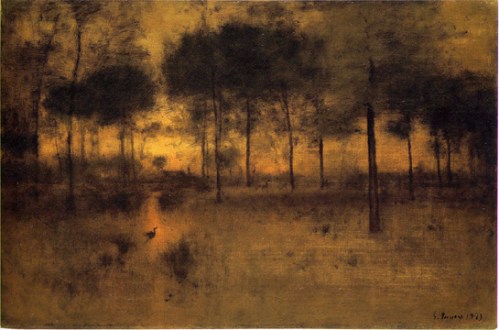
This image, alas, conceals as much as it reveals. It barely hints at the spell this painting casts when you’re standing in front of it. Great paintings defy reproduction. Go. Look.
 music clip of the day