Saturday, 11/20/10
I don’t know how boys do it these days—grow up, that is, without ever dreaming of being a cowboy.
Sunshine Boys (featuring J.D. Sumner), “We’re Gonna Ride on the Golden Range,” 1951 (Prairie Roundup)
I don’t know how boys do it these days—grow up, that is, without ever dreaming of being a cowboy.
Sunshine Boys (featuring J.D. Sumner), “We’re Gonna Ride on the Golden Range,” 1951 (Prairie Roundup)
If you have any doubts about the transformative powers of music, watch this. I’ve spent more hours than I could count in prisons, state and federal, in Illinois and Ohio and Wisconsin, meeting with clients. Never have I seen folks so relaxed.
Johnny Cash, live, San Quentin, 1969
“I Walk the Line”
***
“Folsom Prison Blues”
Vodpod videos no longer available.***
“Orange Blossom Special”
***
“Jackson” (with June Carter Cash)
**********
lagniappe
reading table
There is nothing in our material world more beautiful than the book.
—Patti Smith (after winning this year’s National Book Award for nonfiction for her memoir Just Kids)
His music points toward another world—one more lyrical, more refined, more lucid than this.
Mozart, Piano Sonata No. 14 in C Minor, K. 457/Friedrich Gulda, live, 1981
1st Movement
***
2nd Movement
Vodpod videos no longer available.***
3rd Movement
Vodpod videos no longer available.(This last clip does something odd: instead of ending when the third movement concludes [5:15], it starts over.)
Do not find yourself in the music, but find the music in yourself.
—Heinrich Neuhaus (Russian piano teacher whose students included Sviatoslav Richter, Emil Gilels, Radu Lupu, et al.)
Marilyn Crispell, “Dear Lord” (John Coltrane), live
**********
lagniappe
“Jesus Dropped The Charges” [The O’Neal Twins, Sunday, 11/7/10] made my day.
Find a note that pleases you.
Then another.
And another.
—Cecil Taylor (when asked what advice he would give to a young musician)
Cecil Taylor, live, 1981 (Imagine the Sound)
**********
lagniappe
art beat
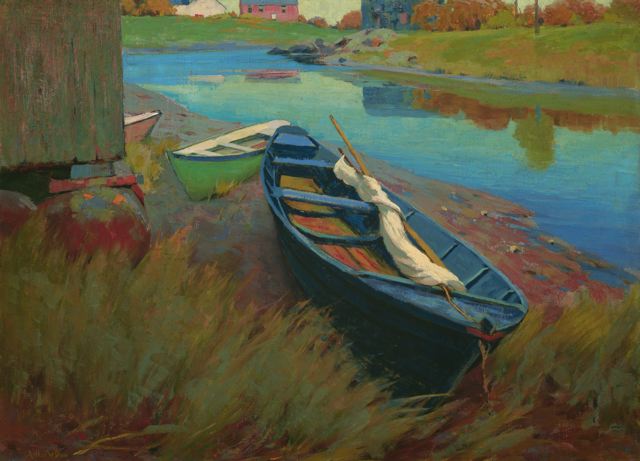
Going to an art museum you never know what you may encounter. This painting, for instance, I’d never laid eyes on—never even heard of the artist—until I happened upon it the other day at Chicago’s Art Institute.
Arthur Wesley Dow (American, 1857-1922), Boats at Rest
Madonna would’ve been a big star back then, too.
“Snake Hips (Do The Wiggle Waggle Woo),” Happy Days (1929), with Sharon Lynn (singer), Ann Pennington (dancer)
**********
lagniappe
reading table
As I sd to my
friend, because I am
always talking, — John, Isd, which was not his
name, the darkness sur-
rounds us, whatcan we do against
it, or else, shall we &
why not, buy a goddamn big car,drive, he sd, for
christ’s sake, look
out where yr going.—Robert Creeley (I Know a Man)
Want to hear Creeley read this? Here (MP3).
MCOTD’s alter ego has a letter in today’s New York Times Book Review.
To the Editor:
In connection with his review of Stephen Sondheim’s “Finishing the Hat” (“Isn’t It Rich?” Oct. 31), Paul Simon, in the Up Front, says that when he wrote the refrain to “Bridge Over Troubled Water” — “Like a bridge over troubled water, I will lay me down” — he had “no idea where those words and melody came from.” It takes nothing away from Mr. Simon to note that one apparent source of inspiration for this line was the Swan Silvertones’ gospel song “Oh Mary Don’t You Weep,” which was released in 1959. That recording, which features the wonderful Claude Jeter on lead vocals, includes the ad-libbed line “I’ll be a bridge over deep water if you trust in my name.” Mr. Simon has previously acknowledged this link.
RICHARD MCLEESE
Oak Park, Ill.
The Swan Silvertones, “Oh Mary Don’t You Weep” (1959): MP3
*****
replay: a clip too good for just one day
If influence were compensable, Claude Jeter of the Swan Silvertones—a huge influence on Sam Cooke, Curtis Mayfield, Eddie Kendricks (Temptations), Al Green, even Paul Simon (who took inspiration from a line in the Swans’ “hit” “Oh Mary Don’t You Weep” [“I’ll be a bridge over deep water if you trust in my name”] when he wrote “Bridge Over Troubled Water”)—would have, when he passed earlier this year at the age of 94, died a wealthy man.
Swan Silvertones, “Only Believe,” live
**********
lagniappe
When he leaves the house [in NYC], he whistles his favorite tune, ‘What A Friend We Have In Jesus,’ while greeting the assorted neighborhood junkies and prostitutes who knew him mainly as sometime manager of the [Hotel] Cecil. ‘What’s new, Jeter,’ they ask. ‘Nothing new, nothing good, just thank God for life up here with these heathens and muggers.’
—Anthony Heilbut, The Gospel Sound: Good News and Bad Times (1971)
(Originally posted on 9/13/09.)
what’s new
(an occasional series)
The Books, “I Didn’t Know That” (2010)
(Want more of The Books? Here.)
*****
Prince Rama, “Om Namo Shivaya” (2010)
*****
Glasser, “Mirrorage” (2010)
three takes
“Love Hurts” (Felice & Boudleaux Bryant)
Keith Richards & Norah Jones, live, Los Angeles, 2004 (Gram Parsons Tribute Concert)
*****
Gram Parsons & Emmylou Harris, live (radio broadcast), 1973
*****
The Everly Brothers, 1960
Looking for a reason to be hopeful?
None of these musicians (or the conductor) is over the age of 18.
John Adams, Shaker Loops (1978), first movement (“Shaking and Trembling”), live
**********
lagniappe
John Adams, rehearsing this music:
*****
It is a strange business, composing music in twenty-first-century America. The job is difficult in itself: it is slow, solitary, and intensely cerebral. You have to believe deeply in yourself to get through the process. You have to be possibly a little mad. When you are done, you have in your hands not a finished object—a painting that can be put up on a wall or a novel that can be read at one sitting—but a set of abstract notations that other musicians must learn and perform. Then you step back into the culture at large, where few people embrace, or even notice, what you do. In this country, classical music is widely regarded as a dead or alien form—so much so that jazz aficionados routinely say, “Jazz is America’s classical music.” To make the counterargument that America’s classical music is America’s classical music is somehow to admit that the battle is lost. In such a climate, composers easily become embittered.
***
When I visited Adams at his house in Brushy Ridge, last June, he was pondering the composer’s relationship with the mass culture. “I like to think of culture as the symbols that we share to understand each other,” he said. “When we communicate, we point to symbols that we have in common. If people want to make a point, they reach for a reference. It might be a Woody Allen movie, or a John Lennon lyric, or ‘I’m not a crook.’ When I was young, I came to realize that twelve-tone music, or for that matter, all contemporary music, was so far divorced from communal experience that it didn’t appear on the national radar screen. It would be nice to hear someone say, ‘Look at that gas station in the moonlight. It’s pure John Adams.’”
***
The music of John Adams, unlike so much classical composition of the last fifty years, has the immediate power to enchant.
—Alex Ross, “The Harmonist,” The New Yorker, 1/8/01
 music clip of the day