Muddy Waters, Saul Bellow, Steppenwolf Theater Company (John Malkovich, John Mahoney, Gary Sinise, Laurie Metcalf, et al.), Curtis Mayfield: a lot of great artists, musical and otherwise, have come out of Chicago in the last 50 years. Among the greatest is this group: the Art Ensemble of Chicago. While the horn players (Roscoe Mitchell, Joseph Jarman, Lester Bowie) got the lion’s share of the attention, what gave their music its juice—what made it dance—was (as you’ll hear) one of the finest rhythm sections ever: Malachi Favors, bass; Don Moye, drums.
Art Ensemble of Chicago, live, Poland (Warsaw), 1982 (in four parts)
Part 1
Part 2
Part 3
Part 4
(I talk about the AEC in the past tense because, while recordings are still released under this name from time to time, with two key members [they were all “key members”] now dead—trumpeter Lester Bowie [1999] and bassist Malachi Favors [2004]—it just isn’t [nor could it be] the same.)
**********
subscribe
Many things in life don’t quite seem, alas, to live up to their billing. It appears that the RSS (Real Simple Syndication) service that’s referenced in the righthand column (under “Subscribe”) may fall into this category—at least, that is, for those of us who are (as the expression goes) of a certain age. The problem seems to lie at the threshold: “real simple.”
Anyway, in the life’s-too-short, keep-it-simple-stupid department, if you’d like to “subscribe” to this blog, just send me an email (Richard McLeese/rmcleeselaw@aol.com) with “subscribe” in the subject line and—voila!—you’ll be added to an ever-growing email list that will have you receiving an e-notice whenever there’s a new blog post. As indicated in the “About” section (see righthand column), this whole thing started from a very small (like, oh, two, sometimes three, folks) email list, which then grew, then grew some more. One of many miraculous things about electronic communication is that there’s always room for one more.
No one’s played blues harmonica more delicately, more lyrically.
“Shakey,” “Mumbles”—no one’s had weirder nicknames.
No one else in my years at Alligator Records (back in the 1970s), where I worked with a lot of musicians who drank more in a day than most folks do in a month, managed to do this: trip over the drum set, right in the middle of a performance (at Notre Dame), and fall over onstage.
With the greatest artists, even the most familiar pieces sound as if you were hearing them for the first time.
Beethoven, Piano Sonata No. 14 in C# minor, Op. 27, No. 2 (“Moonlight”), 1801/Artur Schnabel, piano, 1933
1st & 2nd Movements
*****
3rd Movement
**********
lagniappe
The magnitude of his [Schnabel’s] creative accomplishments left technical considerations far behind. His Beethoven had incomparable style, intellectual strength, and phrasing of aristocratic purity. The important thing was that even when his fingers failed him, his mind never did. Schnabel was always able to make his playing interesting. A mind came through—a logical, stimulating, sensitive mind. And when Schnabel had his fingers under control, which was more often than not in his literature of Mozart, Beethoven and Schubert, he took his listeners to an exalted level. . . . There were no tricks, no excesses; just brain, heart and fingers working together with supreme knowledge.—Harold C. Schonberg, The Great Pianists (1963)
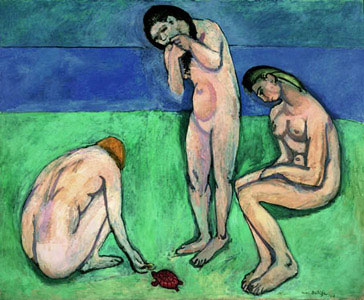
At the risk of repeating myself, the Matisse exhibit at Chicago’s Art Institute closes Sunday (then opens next month at New York’s Museum of Modern Art). How many other opportunities will you have to see this stuff?
Henri Matisse:
Seek the strongest color effect possible . . . the content is of no importance.
***
After a half-century of hard work and reflection the wall is still there.
The impact of the oil from the Gulf of Mexico spill now soiling the Louisiana shoreline was felt far inland on Thursday as P&J Oyster Company, the country’s oldest oyster processor and distributor, ceased its shucking operations.
“The bottom line is that the guys that we purchase from are not working,” said Sal Sunseri, referring to the oyster harvesters who’ve been idled by the mass closure of harvesting areas and freshwater diversions. “Today’s our last day of shucking.”
***
“Having the guy down the street deliver oysters that were shucked just that morning to our doorstep is an amazing thing,” said John Besh, who featured P&J Oysters at his five New Orleans area restaurants. “The relationship is so valuable, knowing that I can count on them to source the best oysters from the saltiest areas and deliver them in a consistent, uniform manner.”
“They provide wonderful oysters,” said Darin Nesbit, chef at the Bourbon House, whose relationship with P&J is so tight Sal Sunseri helped shuck oysters the first night the restaurant opened following Hurricane Katrina. “Even in times of trouble, they’ve always taken care of us.”
P&J was started in 1876 by John Popich, a Croatian immigrant who took on partner Joseph Jurisich at the turn of the century. In 1921, Popich and Jurisich purchased a shucking house at the corner of Toulouse and North Rampart streets. Alfred Sunseri, the current owners’ grandfather, who was married to Popich’s cousin, joined the company soon after.
You’re right, not only can’t you lip-synch this stuff; you can’t really sing it if you don’t know it in your heart. That’s why it’s sooooo good. [The Pilgrim Jubilees, 6/13/10]
Cab Calloway and His Orchestra; Nicholas Brothers, dancers; “Jumpin’ Jive”
**********
lagniappe
Fred Astaire told the [Nicholas] brothers that the “Jumpin’ Jive” number in Stormy Weather was the greatest number he had ever seen on film. He would have been more impressed had he known that the choreography was filmed all in one take.
—Constance Valis Hill, Tap Dancing America: A Cultural History (2010)
With some music, it’s the particular sound a musician coaxes out of his instrument that gets under your skin. Here’s one of the dirtiest, snakiest electric guitar sounds around.
Group Doueh (featuring Baamar Salmou AKA Doueh on electric guitar), live, Western Sahara





 music clip of the day