Tuesday, 5/11/10
Lena Horne, June 30, 1917-May 9, 2010
Lena Horne, “Stormy Weather” (Stormy Weather, 1943)
Lena Horne, June 30, 1917-May 9, 2010
Lena Horne, “Stormy Weather” (Stormy Weather, 1943)
YouTube giveth, and YouTube taketh away.
I’ve posted other clips that were subsequently removed by YouTube. But this is the first time where I’ve posted something that was removed the very same day.
Oh, well—more tomorrow.
**********
When the tempo is perfect, the music unfolds in what seems to be the only way it could. “Fast” and “slow” lose their meaning. Time disappears.
Frederic Chopin, 24 Preludes for Solo Piano, Op. 28/Friedrich Gulda, piano
Nos. 15, 10, 9, 3, 4
*****
Nos. 7, 13, 21, 24
Want more? Here.
New Orleans Jazz & Heritage Festival, 2010/part 3
Aaron Neville, “Amazing Grace”
New Orleans Jazz & Heritage Festival, 2010/part 2
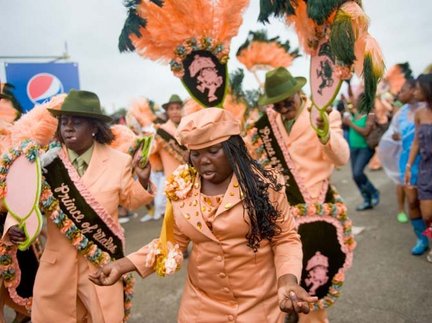
Scene 1: Parade of the New Orleans Social Aid and Pleasure Club
*****
Scene 2: Chouval Bwa
*****
Scene 3: Trombone Shorty and Orleans Avenue, “Backatown” (record-store performance)
*****
Scene 4: Pinettes Brass Band (outside another record store)
**********
lagniappe

New Orleans Jazz & Heritage Festival, 2010/part 1
Scene 1: Sousaphone Parade
*****
Scene 2: Brian Blade & The Fellowship
Want more Brian Blade? Here.
*****
Scene 3: Mardi Gras Indians (Members of the Golden Star Hunters, Carrolton Hunters, et al.), Backstage
Want more Mardi Gras Indians? Here.
**********
lagniappe
I was about 16 when I had an experience that I recollect in nearly Proustian detail, listening for the first time to the String Quartet in C-sharp Minor, op. 131. I was sitting in a friend’s living room when her father put a recording of it on the hi-fi. I remember everything about those three-quarters of an hour back in 1961 or ’62: the room in which I was sitting and the direction in which I was facing; the single, exposed Bozak speaker vibrating like an exotic organism in the unfinished wooden box that Mr. L. had built to contain it; the quickly dawning realization that the first movement was the most overwhelming piece of music I had ever heard—a feeling that comes back to me whenever I listen to it, in real sound or mentally, as at this moment; and I remember (but this memory comes also from countless later listenings) the mysterious, throbbing sound of the first violin’s statement of the opening subject in that recording, made by the Budapest Quartet in the early 1950s.
***
I am now several years older than Beethoven lived to be. I still think of him as my alpha and omega, but in a different sense: as the author of music that transformed my existence at the onset of adulthood and that continues to enrich it more than any other music as I approach what are often referred to as life’s declining years. His music still gives me as much sensual and emotional pleasure as it gave me 50 years ago, and far more intellectual stimulation than it did then. It adds to the fullness when life feels good, and it lengthens and deepens the perspective when life seems barely tolerable. It is with me and in me. A thousand or 5,000 or 10,000 years from now, Beethoven and our civilization’s other outstanding mouthpieces may still have much to communicate to human beings—if any of our descendants are still around—or they may seem remote, cold, obscure. But what matters most in Beethoven’s case is his belief that we are all part of an endless continuum, whatever our individual level of awareness may be. In the Ninth Symphony, he used Schiller’s words to tell us explicitly what many of his other works, especially his late works, tell us implicitly: that the “divine spark” of joy and the “kiss for the whole world,” which originate “above the canopy of stars,” must touch and unite us all. The spark is there, he said, and so is the kiss; we need only feel and accept their presence.—Harvey Sachs
*****
Beethoven, String Quartet No. 14 in C-sharp minor, op. 131/1st Movement
Budapest Quartet, 1943
*****
Busch Quartet, 1936
Without hitting you over the head with his classical training, this guy, early in his career, took pop songs to new places—melodically, harmonically, structurally.
Randy Newman
Dusty Springfield, “I Don’t Want To Hear It Anymore” (1969)
*****
“Just One Smile”
Gene Pitney (1966 [#8, UK Charts])
***
Blood, Sweat & Tears (1968)
*****
Randy Newman, live (TV broadcast [with The BBC Concert Orchestra, London]), “I Think It’s Going To Rain Today” (2008; first recorded in 1966 [Julius LaRosa, 8/66; Judy Collins, 11/66])
**********
lagniappe
To me, someone who writes really good songs is Randy Newman. . . . You know, he’s got that down to an art. Now Randy knows music. He knows music.—Bob Dylan (1991)
How often do you get to witness something of this historical magnitude—the first MCOTD clip directed by a MCOTD reader? (Before suspicious minds begin to wonder, let me assure you that this selection was untainted by payola—MCOTD cannot be bought [at least not cheaply].)
Man/Miracle, “Pushing and Shoving” (2010)
**********
lagniappe
art beat
William Eggleston (Art Institute exhibit closes May 23rd)

Want more? Here.
this just in from my (almost-19-year-old) son Luke
K’naan, “Take A Minute”
lagniappe
more from Luke
Kanye West with Drake & Lupe Fiasco
*****
listening room
WKCR-FM (broadcasting from Columbia University) is hosting a Country Music Festival through tomorrow, playing “full programs of country radio’s heyday from the 1930s to the 1960s” —Grand Ole Opry, Sage Brush Round Up, Louisiana Hayride, Mother’s Best Flour, etc.
*****
increasingly difficult
Yesterday someone happened upon this site via the following search (which hit on the recent Duke Ellington post):
it is becoming increasingly difficult to
*****
art beat
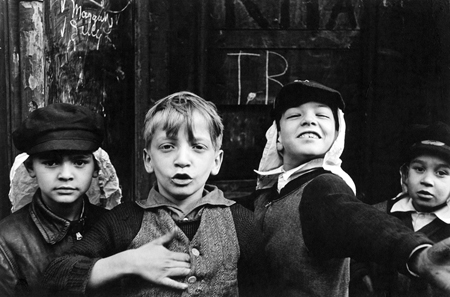
Helen Levitt (c. 1940)
The records this man made, during sessions in Dallas in the 1920s, where he played an instrument that has long mystified listeners (dolceola? fretless zither?), are like nothing else I know.
Washington Phillips
“Lift Him Up” (1927, Dallas)
*****
“What Are They Doing In Heaven Today?” (1928, Dallas)
*****
“Denomination Blues,” Part 1 (1927, Dallas)
**********
lagniappe

 music clip of the day
